

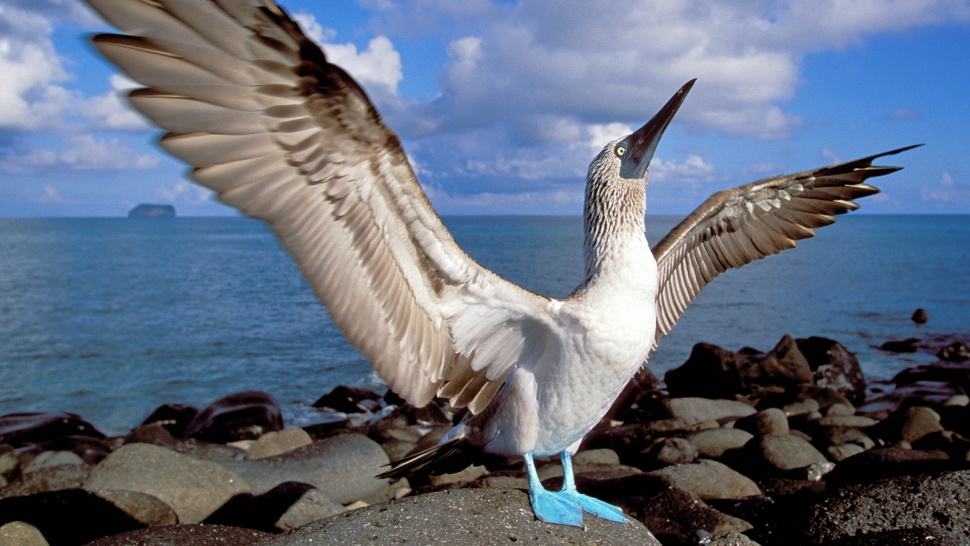

Let's start just by his name: Booby, which is derived from the Spanish word Bobo, which means "stupid" or "clown”. This name was given because of its comical and a bit clumsy behavior when maneuvering on the ground. It is also considered a bit silly because of its fearlessness, especially of the way males seduce females.
The males of these birds have quite similar behavior as clumsy men who are trying to win the girl of their dreams by making a fool of themselves. First, they come forward and throwback wings on their back and whistle (yes, literally whistle) as the female is passing by. At the same time they throw out their blue "legs" and parade like that for hours, until they draw the attention of a female to themselves. In addition to acting awkward, clumsy or whatever you prefer to call it, blue-footed Booby birds are still persistent and do not give up on their tactics.

Very often, they lift one - and then the other foot in front of the female, spreading wings and lifting neck to heaven, while a shy female at the same time hides her head under the wings.
However, it seems that the style of seduction does not play so important role, since those with the bluest feet first find a female. In the world of blue-footed Booby, there is a rule "the bluer feet, the more attractive." When a seductive parade, bragging with the blue legs and whistling are finished, and when blue-footed Booby finally finds partner, it mainly enters in monogamy lifestyle. So, these are the birds that are dedicated to the family and are not "womanizers" in nature.
Blue-footed Booby lives between 15-20 years, grows up to 90cm with a wingspan of up to 1.5 meters. They inhabit several locations of the Eastern Pacific, mostly rocky landscapes, and most of them are settled in the Galapagos, where it is estimated that there are about 20,000 pairs.
Share the News