

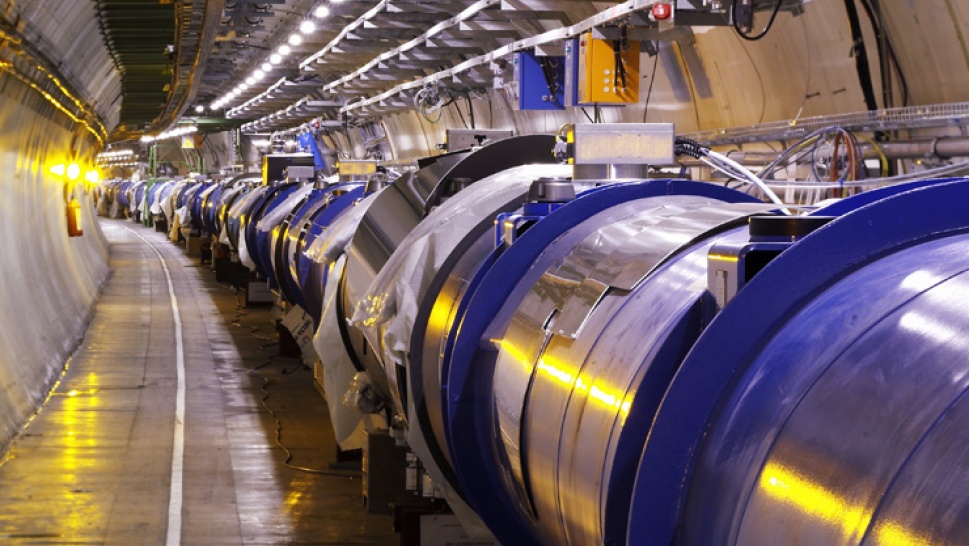

The Large Hadron Collider (LHC) is the largest and most powerful particle accelerator in the world. It first started up on September 2008, and remains the latest addition to CERN’s accelerator structure. The Collider consists of a 27-kilometre circle of superconducting magnets with a number of accelerating upgrades to boost the energy of the particles.
Inside the accelerator, two high energy particle beams travel at close to the speed of light before they collide. The beams travel in opposite directions through separate beam pipes – two tubes kept at ultrahigh vacuum. They are guided around the accelerator ring by a strong magnetic field maintained by superconducting electromagnets. The electromagnets are built from coils of special electric cable that operates in a superconducting state, efficiently conducting electricity without resistance or loss of energy. This requires chilling the magnets to ‑271.3°C, the temperature colder than the one in outer space.
On November 20 in 2014 CERN frees LHC data. Anyone can access collision data from the Large Hadron Collider through the new CERN Open Data Portal.
“Data from the LHC program are among the most precious assets of the LHC experiments, that today we start sharing openly with the world,” says CERN Director General Rolf Heuer. “We hope these open data will support and inspire the global research community, including students and citizen scientists.”
All data on http://OpenData.cern.ch are shared under a Creative Commons CC0 public domain dedication.
The purpose of the LHC is to increase our knowledge of the universe and matter. It's a machine built to further our understanding. Considering that the LHC costs billions of dollars and requires the cooperation of numerous countries, the project may be the biggest scientific experiment ever conducted.
Share the News