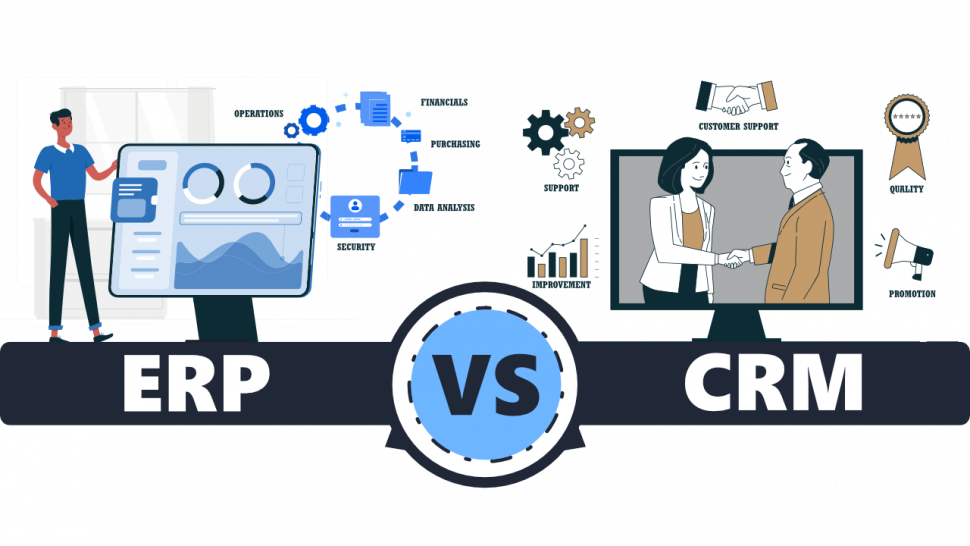

business environment, managing operations and customer relationships efficiently is critical for success. Two of the most widely used software solutions to achieve this are ERP (Enterprise Resource Planning) and CRM (Customer Relationship Management). While both systems are designed to streamline business processes, they serve different purposes and cater to distinct aspects of a business.
If you’re trying to decide between ERP and CRM—or wondering if you need both—this guide will break down everything you need to know. We’ll explore what ERP and CRM are, their key differences, how they benefit businesses, and which one is right for your needs. Let’s dive in!
What is ERP?
ERP, or Enterprise Resource Planning, is a comprehensive software system designed to integrate and manage core business processes across an organization. It acts as a centralized platform that connects various departments, such as finance, HR, supply chain, manufacturing, and inventory management, into a single system.
Key Features of ERP:
Financial Management: Tracks accounting, budgeting, and financial reporting.
Supply Chain Management: Manages procurement, inventory, and logistics.
Human Resources: Handles payroll, recruitment, and employee performance.
Manufacturing: Streamlines production planning and quality control.
Reporting and Analytics: Provides real-time insights into business performance.
Benefits of ERP:
Improved Efficiency: Automates repetitive tasks and reduces manual errors.
Better Decision-Making: Offers real-time data and analytics for informed decisions.
Cost Savings: Optimizes resource allocation and reduces operational costs.
Scalability: Grows with your business, supporting expansion and new processes.
What is CRM?
CRM, or Customer Relationship Management, is a software system focused on managing interactions with current and potential customers. It helps businesses build and maintain strong relationships with their customers by organizing, tracking, and analyzing customer data.
Key Features of CRM:
Contact Management: Stores and organizes customer information.
Sales Automation: Tracks leads, deals, and sales pipelines.
Marketing Automation: Manages campaigns, email marketing, and customer segmentation.
Customer Support: Provides tools for ticketing, live chat, and support teams.
Analytics and Reporting: Tracks customer behavior and sales performance.
Benefits of CRM:
Enhanced Customer Relationships: Improves communication and personalization.
Increased Sales: Streamlines the sales process and boosts conversion rates.
Better Marketing ROI: Targets the right audience with data-driven campaigns.
Improved Customer Retention: Identifies and addresses customer issues proactively.
ERP vs. CRM: Key Differences
While ERP and CRM are both essential tools for modern businesses, they serve different functions and address distinct needs. Here’s a breakdown of their key differences:
Aspect ERP CRM
Primary Focus Internal business processes and operations Customer interactions and relationships
Key Users Finance, HR, supply chain, manufacturing Sales, marketing, customer support
Main Goal Streamline operations and improve efficiency Enhance customer satisfaction and sales
Data Managed Financial, inventory, HR, production data Customer, sales, and marketing data
Integration Connects internal departments Connects customer-facing teams
Do You Need ERP, CRM, or Both?
The choice between ERP and CRM depends on your business needs, goals, and challenges. Here’s how to decide:
When to Choose ERP:
You need to streamline internal operations like finance, inventory, or HR.
Your business is growing, and you’re struggling to manage multiple processes.
You want to improve operational efficiency and reduce costs.
You need real-time insights into your business performance.
When to Choose CRM:
Your focus is on improving customer relationships and increasing sales.
You want to automate and optimize your sales and marketing processes.
You need better tools to track leads, manage customer data, and provide support.
Your goal is to enhance customer retention and satisfaction.
When to Use Both:
Your business requires both operational efficiency and customer focus.
You want to integrate customer data with internal processes for a 360-degree view.
You’re looking to scale your business while maintaining strong customer relationships.
Many modern businesses use both ERP and CRM systems, often integrating them to create a seamless flow of information between internal operations and customer-facing teams.
Real-World Examples of ERP and CRM in Action
ERP Example:
A manufacturing company uses an ERP system to manage its production schedule, inventory levels, and financial reporting. The best ERP software ensures that raw materials are ordered on time, production runs smoothly, and financial data is accurate and up-to-date.
CRM Example:
A retail business uses a CRM system to track customer purchases, send personalized marketing emails, and manage customer support tickets. The CRM development company helps the business identify loyal customers, target them with special offers, and resolve issues quickly.
FAQs About ERP and CRM
1. Can ERP and CRM systems be integrated?
Yes, many businesses integrate ERP and CRM systems to create a unified platform. Integration allows for seamless data flow between internal operations and customer-facing teams, providing a complete view of the business.
2. Which is more expensive: ERP or CRM?
ERP systems are generally more expensive due to their complexity and wide range of features. CRM systems are often more affordable, especially for small businesses. However, costs vary depending on the vendor, features, and customization required.
3. Can small businesses benefit from ERP and CRM?
Absolutely! Small businesses can benefit from both ERP and CRM systems. Many vendors offer scaled-down versions or cloud-based solutions that are affordable and easy to implement for smaller organizations.
Conclusion
ERP and CRM are powerful tools that serve different but complementary purposes. While ERP focuses on optimizing internal operations, CRM is all about enhancing customer relationships. The choice between the two—or the decision to use both—depends on your business goals, challenges, and resources.
If you’re looking to streamline operations and improve efficiency, ERP is the way to go. If your priority is to boost sales and build stronger customer relationships, CRM is the better choice. For many businesses, integrating both systems provides the best of both worlds, enabling them to operate efficiently while delivering exceptional customer experiences.
By understanding the differences and benefits of ERP and CRM, you can make an informed decision that aligns with your business needs and sets you up for long-term success.


Share the News