

Executive Summary of the GloBra / GLBrain / GLMall Patent Position
Overall Assessment
After reviewing the U.S. patent, the first European patent, and the recently granted European Unitary Patent EP4529084, my conclusion is that GloBra possesses a significantly stronger intellectual property position than most blockchain, social-network, marketplace, or Web3 startups.
This is not a case of a company holding a single patent around a token, payment process, or isolated software feature. Instead, the patents form an increasingly coherent portfolio around a broader architectural concept: user-owned data, relationship-based data structures ("data chains"), immutable agreements, and blockchain-secured verification. The portfolio appears to protect the platform's underlying operating model rather than merely a single application of it.
1. What Makes the Portfolio Different?
Most social networks operate on a simple principle:
• The platform owns the data.
• The platform creates user profiles.
• The platform controls access.
• The platform monetizes user information.
The GloBra patents describe a different architecture in which:
• Users own their data.
• Users control access rights.
• Relationships are created through predefined "data chains."
• Data chains can create immutable records.
• Immutable records can be secured on an external blockchain.
This concept is consistently present throughout the patent family.
The patents are therefore not simply about blockchain.
They are primarily about data ownership, data governance, relationship management, and trust creation.
2. Strength of the Original European Patent
The first European patent established the foundation:
• User-owned data blocks.
• Data chains connecting users.
• Internal immutable receipt systems.
• External blockchain anchoring.
• Smart agreements.
• Payment integration.
This patent protects the combination of these elements rather than blockchain technology itself.
Its strength lies in the architecture.
Its weakness is that competitors may attempt to achieve similar business outcomes using different technical structures.
Nevertheless, it creates meaningful protection for the specific implementation used by GLBrain and GLMall.
3. Strength of the U.S. Patent
The U.S. patent strengthens the position considerably.
Unlike many software patents that are vulnerable to being characterized as abstract business methods, the U.S. patent is framed as:
• servers,
• processing circuitry,
• storage devices,
• executable instructions,
• relational database structures,
• blockchain verification systems.
This technical framing generally improves enforceability in the United States.
The U.S. patent therefore provides protection in the world's most important technology and licensing market.
4. Why the New European Unitary Patent Is Important
The most recent development may actually be the most strategically significant.
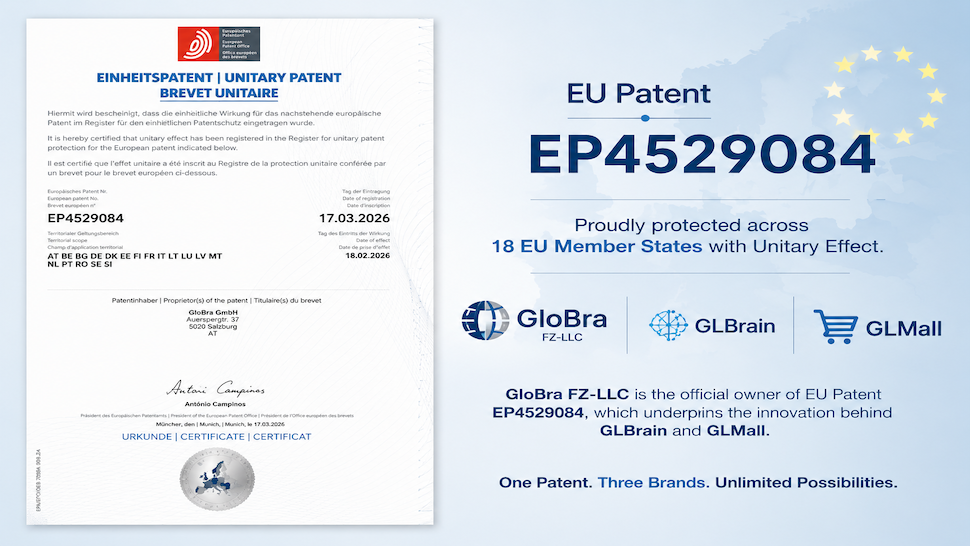
The newly granted European Unitary Patent EP4529084 reduces dependence on payment processing and focuses on the core architecture itself.
The independent claims concentrate on:
• data blocks,
• data chains,
• relationship structures,
• user control,
• immutable records,
• programmable functions attached to relationships.
This is important because payment systems can change. Core architecture rarely changes.
A competitor can easily replace a payment method. Replacing the entire data relationship structure of a platform is far more difficult.
In many respects, this second patent may ultimately prove more valuable than the payment-related claims.
5. The Emerging Patent Portfolio
The patents now appear to create several layers of protection:
Layer 1 – User-Owned Data Architecture
Protection of data blocks, ownership structures, and user-controlled information.
Layer 2 – Data Chain Technology
Protection of the relationship architecture connecting users and content.
Layer 3 – Immutable Internal Records
Protection of fixed agreements, receipts, certifications, and records.
Layer 4 – Blockchain Verification
Protection of transferring and securing records on independent blockchains.
Layer 5 – Smart Agreements and Payments
Protection of transaction-related and smart-agreement functions.
This layered approach is considerably stronger than relying on a single patent.
6. Can Large Companies Copy It?
This question must be answered carefully.
What the patents probably do protect
The patents likely make it difficult for competitors to copy the exact GLBrain / GLMall architecture without significant legal analysis and redesign.
A company implementing the same concepts in substantially the same way could face infringement risks.
Final Assessment: My current assessment is:
Category Assessment
Technical originality High
Patent quality Above average
U.S. protection Strong
European protection Strong
Portfolio development Strong
Licensing potential Significant
Protection against direct copying Strong
Protection against all competitors Moderate
Strategic value if platform scales High
Overall Conclusion
The patent position of GloBra is substantially stronger than that of a typical startup. The combination of a U.S. patent, an earlier European patent, and the new European Unitary Patent creates what is now best described as an emerging platform-level intellectual property portfolio.
The patents do not prevent others from building social networks, marketplaces, or blockchain applications. However, they do appear to provide meaningful protection for the specific user-owned data architecture, data-chain technology, immutable agreement framework, and blockchain verification model that underpin the GLBrain and GLMall ecosystem. From a strategic perspective, this represents a genuine competitive asset and a potentially valuable licensing position if the platform achieves significant market adoption.
Share the News