

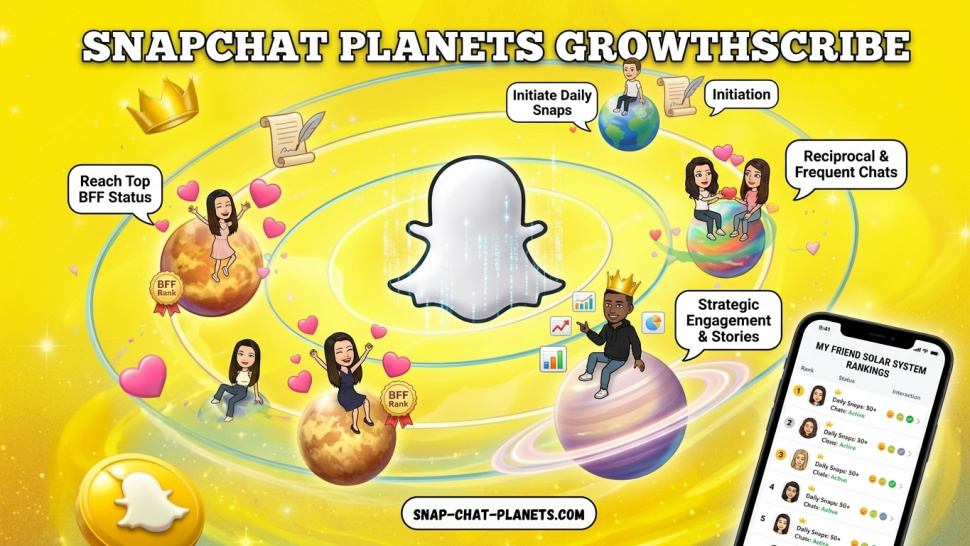

For years, the internet has been saturated with basic guides explaining the colors and names of the various planets in Snapchat’s premium Friend Solar System. We all know by now that Mercury means number one and Neptune means number eight. But as digital communication evolves in 2026, users are no longer satisfied with simply sitting back and letting a black-box algorithm dictate their social hierarchy. Today’s high-volume search trends reveal a major shift: users want to know how to control their digital orbits. Instead of passively watching your friends shift from Earth to Mars, it is time to understand the exact mechanics that power this feature. If you want a basic refresher on the standard tiers, you can review the snapchat bsf list planets, but in this comprehensive guide, we are moving beyond the basics. We are diving into the exact algorithmic weights, the strategies to fast-track a friend to the number one spot, and the stealth methods to silently drop an overly active user out of your top eight.Welcome to the playbook for reverse-engineering your digital galaxy.Moving from Passive Observer to Active ArchitectThe Friend Solar System is, at its core, a data visualization tool. It takes thousands of micro-interactions—every photo sent, every text typed, every second spent watching a Story—and distills them into a single, cohesive ranking system. However, algorithms are just math, and math can be manipulated.When you understand that your planetary ranking is not a reflection of your "true" friendship but rather a reflection of your data throughput, you gain the ability to curate your social space. Whether you are trying to impress a new romantic interest by making sure they see themselves as your "Venus," or you are trying to establish a professional distance from a colleague who snaps you too often, mastering this algorithm is the ultimate modern social skill.The Core Algorithm: What Actually Powers the Gravity?To manipulate the system, you must first understand the "gravity" that pulls a user closer to your Sun. Snapchat does not weigh all interactions equally. Here is the hierarchy of digital actions that dictate planetary placement:1. The Undisputed King: Media Snaps (Photos and Videos)The fundamental building block of Snapchat is the Snap itself. Sending and opening photo or video Snaps carries the highest algorithmic weight. However, it is not just about outbound volume. The algorithm heavily favors reciprocity. Sending 100 Snaps to someone who only opens them and never replies will not make them your Mercury. The system looks for closed loops: You send a Snap, they open it, they reply with a Snap, you open it. This "ping-pong" effect is the fastest way to build gravitational pull.2. The Silver Medalist: Chat Frequency and SpeedText-based chatting within the app is the second most important metric. But there is a hidden layer here: response time. Snapchat’s algorithm actively monitors how quickly you reply to a specific user compared to others. If you consistently reply to User A within two minutes but leave User B on delivered for four hours, the algorithm categorizes User A as a higher-priority relationship, pushing them closer to the center of your solar system.3. The Bronze Medalist: Shared Media and LinksSending TikToks, Instagram Reels, or internal Snapchat Spotlight videos through the chat function adds a moderate amount of weight to your relationship score. While not as powerful as native camera Snaps, a high volume of shared external media signals to the app that your communication channel is active and multi-dimensional.4. The Zero-Weight Actions (The Myths)It is vital to debunk what does not work. Passively watching someone's public Story does not affect your Best Friends list. Furthermore, simply maintaining a Streak by sending one blank Snap a day is not enough to maintain a high-ranking planet if you are actively chatting and snapping other people multiple times a day. A Streak keeps the flame alive, but it does not guarantee a Mercury or Venus placement.The "Mercury Hack": Fast-Tracking Someone to Number OneLet’s say you have a specific goal: You want a friend who is currently hovering around Saturn (number six) to become your Mercury (number one) by the end of the week. Because the algorithm relies on a rolling 14-day window of activity, recent intense activity can override older data. Here is the exact blueprint to accelerate their orbit:Phase 1: The Dual-Channel AssaultDo not rely on just sending photos. You need to activate both primary data channels: Snaps and Chats. Send a photo Snap, but add text that requires a specific, detailed response. When they reply, respond via text chat, then follow up with another photo. This creates overlapping interaction loops.Phase 2: The Multi-Media ShiftMigrate your conversations from other apps. If you normally text this person via iMessage or WhatsApp, move that conversation entirely to Snapchat for five days. The sudden, massive influx of data throughput exclusively on Snapchat’s servers will shock the algorithm, rapidly escalating their rank.Phase 3: The Audio OverrideA lesser-known variable in the 2026 algorithm update is the weight of Audio and Video calls. Initiating a live video or audio call through the Snapchat interface signals a premium level of intimacy. A 15-minute audio call via Snapchat can do the algorithmic work of 50 individual photo Snaps.The "Neptune Fade": Silently Dropping Someone from Your OrbitConversely, there are times when someone has climbed too high on your list. Perhaps a casual acquaintance is snapping you relentlessly, and they have unexpectedly parked themselves on Earth (number three). You want to drop them out of your top eight entirely, but you want to do it without the social friction of blocking or unadding them. You need the "Neptune Fade."Step 1: The Half-Swipe DelayDo not open their Snaps immediately. Use the "half-swipe" technique to read their messages without triggering the read receipt, and intentionally delay your official open and response by 8 to 12 hours. By drastically increasing your response time, you signal to the algorithm that this user is a low priority.Step 2: Break the LoopWhen you do reply, do not reply with a photo Snap. Reply with a short text message, or even better, a simple Bitmoji reaction. By converting high-weight interactions (Photos) into low-weight interactions (Reactions), you strip away their algorithmic gravity.Step 3: The Group Chat BufferIf you must communicate with them, move the conversation into a Group Chat. Interactions within a Group Chat are diluted and do not carry the same one-to-one weight as direct messaging. You can maintain contact without artificially boosting their personal planetary rank. Within 7 to 10 days of the "Neptune Fade," they will naturally drift out of your top eight.The Overriding Factor: Pinned Best Friends and Snapchat+One of the most frequent questions from advanced users is how the "Pin as #1 Best Friend" feature interacts with the Solar System. If you have Snapchat+, you have the power to permanently pin one person to the top of your chat feed.But does pinning someone magically make them your Mercury?The short answer is No, but it creates a parallel reality.When you pin someone as your #1 Best Friend, the app forces them to the top of your visual interface, guaranteeing they are the first person you see. However, the Solar System feature still relies on raw data. If you pin your romantic partner as #1, but you spend all day sending Snaps to your college roommate, your roommate will still show up as Mercury in the Solar System, while your partner might be Venus or Earth.The Solar System is an unflinching auditor of your actual behavior, regardless of who you have manually pinned. If you want your pinned #1 to also be your Mercury, your actual data output must match your manual selection.Why We Obsess Over the OrbitIt is worth pausing to ask why high-volume search trends are so focused on manipulating this feature. Why do we care so deeply about our digital solar systems?The answer lies in the psychological concept of "visible social currency." In previous decades, friendship hierarchy was an internal, private understanding. Today, platforms like Snapchat have quantified it. When a metric is quantified, human nature dictates that we want to optimize it.The Solar System is essentially a real-time leaderboard of our social lives. Controlling it gives users a sense of agency in a digital world that often feels chaotic and algorithmically overwhelming. By actively managing your list, you are reclaiming control over your social narrative, ensuring that the people who matter most to you in the real world are accurately reflected in your digital universe.Frequently Asked Questions: Myth-Busting the SystemTo round out your understanding, let’s definitively address the most common rumors surrounding the Best Friends algorithm:Does viewing someone’s location on the Snap Map boost their rank? No. Snap Map activity is completely isolated from the communication algorithm. You can check someone's location 50 times a day, and it will not move them an inch closer to your Sun.Do saved chats count more than disappearing chats? Yes. Chats that are saved in the feed (set to 24 hours or manually saved) indicate to the algorithm that the conversation has lasting value, slightly boosting the interaction weight compared to instant-delete messages.Can someone tell if I am purposefully ignoring them to drop their rank? Not explicitly. Because the Solar System is dynamic, users expect fluctuations. Unless they are meticulously tracking their rank on your profile every single day, a gradual "Neptune Fade" appears entirely natural.ConclusionSnapchat’s Friend Solar System is much more than a colorful array of space-themed icons; it is a highly responsive, data-driven engine. While the app wants you to believe you are just along for the ride, you now possess the exact blueprint required to take the wheel.By understanding the weight of photo Snaps versus text, mastering the art of response-time manipulation, and utilizing the dual-channel assault, you can curate your digital galaxy with absolute precision. You no longer have to wonder why someone is sitting on Mars when they should be on Venus. You have the tools, the strategy, and the algorithmic knowledge to put them exactly where they belong. Happy hacking.
How to Reverse-Engineer and Control Your Snapchat Solar System
Keywords:
Share the News