


Envelopes may look like a small part of business stationery, but choosing the wrong size, material or design can create unnecessary costs. A company may order hundreds of printed envelopes and later discover that its documents do not fit properly, the artwork looks misaligned or the paper quality is unsuitable.
These problems can lead to reprinting, delayed dispatch and wasted stationery. Businesses can avoid most of these issues by checking a few important details before approving an envelope order.
1. Confusing Paper Size With Envelope Size
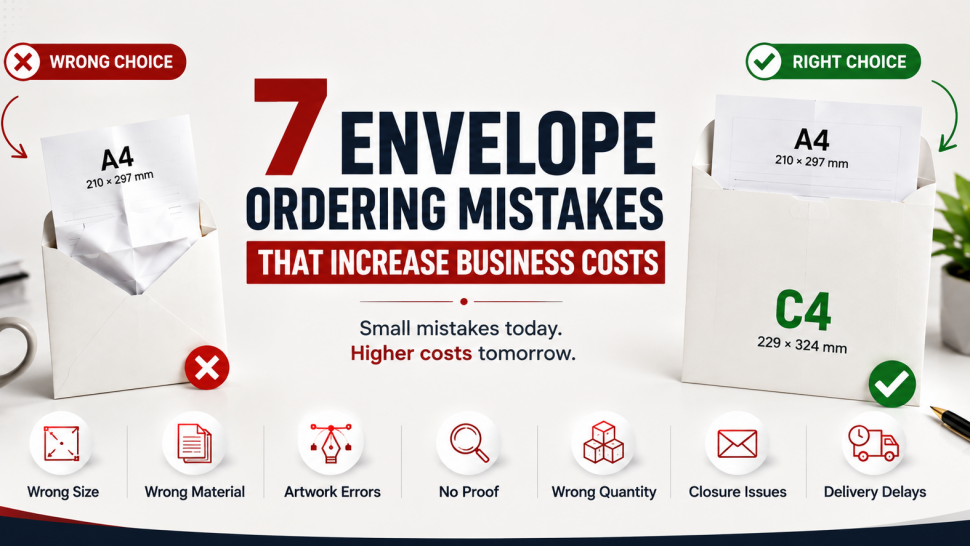
One of the most common mistakes is treating A4 as an envelope size.
A4 is a paper format measuring 210 × 297 mm. A C4 envelope measures 229 × 324 mm and is designed to hold an A4 sheet without folding.
The two formats are related, but they are not the same.
When a supplier uses the term “A4 envelope,” the buyer should ask for the exact measurements. The envelope may be designed to hold an A4 sheet flat, folded once or folded into thirds.
Confirming the dimensions before placing an order can prevent an expensive size mismatch.
2. Choosing the Wrong Envelope Format
Businesses use different envelope formats depending on how the document needs to be presented.
Envelope format Standard size Suitable for
C4 229 × 324 mm Holds A4 paper flat
C5 162 × 229 mm Holds A4 paper folded once
DL 110 × 220 mm Holds A4 paper folded into thirds
C4 envelopes are suitable for certificates, contracts, proposals, reports and legal documents that should remain flat.
C5 envelopes are more compact and work well when folding the A4 sheet once is acceptable. DL envelopes are commonly used for invoices, statements and standard business letters.
Choosing a format without considering the folding requirement may affect both presentation and mailing convenience.
3. Ignoring Paper GSM and Material Quality
The thickness and quality of the envelope paper influence its appearance, strength and handling.
Lightweight paper may work for regular office communication. However, important business documents may require stronger paper for better protection and presentation.
Before ordering, businesses should confirm:
Paper GSM
Paper finish
Colour
Opacity
Suitability for printing
Resistance to handling and tearing
A lower price may not always provide better value. If the envelope tears easily or allows the document to show through, the business may need to replace the order.
The right paper should match the type of document, expected handling and brand image.
4. Creating Artwork Before Confirming the Size
Designing the envelope before confirming its dimensions can create avoidable artwork problems.
The available printing area changes with each envelope size. A logo, company address or decorative element designed for a C4 envelope may not fit correctly on a smaller C5 or DL format.
This can result in:
Incorrect logo placement
Text too close to the edge
Limited address space
Cropped design elements
Repeated artwork revisions
Delayed production
The correct process is to finalise the envelope size first and then prepare the artwork using the printer’s recommended dimensions and safe margins.
Businesses should also leave sufficient blank space for the recipient’s address, courier label or postal information.
5. Approving Artwork Without Checking Business Details
A spelling mistake in an email address, phone number or office location can affect the entire order.
Before approving the design, carefully check:
Company name
Logo quality
Office address
Phone number
Email address
Website URL
GST details, when included
Brand colours
Printing alignment
Return address
The final proof should be reviewed by more than one person when possible. A second review can identify errors that the original designer or buyer may have missed.
Businesses should never approve envelope artwork only by looking at the overall design. Every printed detail should be checked individually.
6. Placing a Bulk Order Without Reviewing a Proof
Bulk printing can reduce the price per envelope, but it also increases the cost of a mistake.
A company ordering 500 or 1,000 envelopes should review a digital proof before production. For larger or more important orders, a physical sample may also be useful.
A proof helps confirm:
Final envelope dimensions
Document fit
Logo size
Text accuracy
Colour appearance
Printing position
Paper quality
Closure style
For example, businesses sending certificates, contracts or proposals can use custom C4 envelopes to keep A4 documents flat and professionally presented.
Before placing the full order, insert the actual document into a sample envelope. This simple check can prevent an entire batch from being printed in the wrong size.
7. Ignoring Closure Type and Delivery Time
The envelope closure should match its intended use.
Common closure options may include:
Gum flap
Self-adhesive closure
Peel-and-seal strip
Open flap
Reusable fastening
A regular gum flap may be suitable for standard mailing, while a self-adhesive option may be more convenient for businesses packing a large number of documents.
Production and delivery time are also important. Businesses often focus only on printing cost and forget to confirm how long artwork approval, production, dispatch and shipping will take.
This can become a problem when envelopes are needed for:
Events
Certificate distribution
Tender submission
Employee onboarding
Client proposals
Legal correspondence
Product launches
The delivery timeline should be confirmed before the order is approved, especially when the documents must be sent by a fixed date.
A Simple Envelope Ordering Checklist
Before confirming an envelope printing order, check the following:
Exact envelope dimensions in millimetres
Document size and folding requirement
Paper GSM and finish
Printing side and printing area
Logo and contact details
Closure type
Minimum order quantity
Digital proof or physical sample
Production time
Delivery timeline
This checklist can help reduce artwork corrections, reprinting costs and dispatch delays.
Why the Right Envelope Matters
An envelope is often the first physical part of a business document that the recipient sees. A clean, properly sized and well-printed envelope can improve the presentation of the documents inside.
The correct envelope also helps:
Protect important papers
Prevent unnecessary folding
Maintain consistent branding
Simplify document packing
Improve professional appearance
Reduce printing waste
Avoid repeat orders
Small stationery decisions can have a noticeable effect when a business sends documents regularly or orders envelopes in large quantities.
Final Thoughts
Most envelope-ordering problems are caused by missing details rather than complicated printing issues.
Businesses should not rely only on names such as A4 envelope, document envelope or large envelope. They should confirm the exact size, paper quality, artwork area, closure type and delivery timeline before production begins.
A4 is a paper size, while C4 is the envelope size commonly used to hold it flat. Understanding this basic difference can help businesses protect their documents, reduce waste and avoid unnecessary reprinting costs.


Share the News