
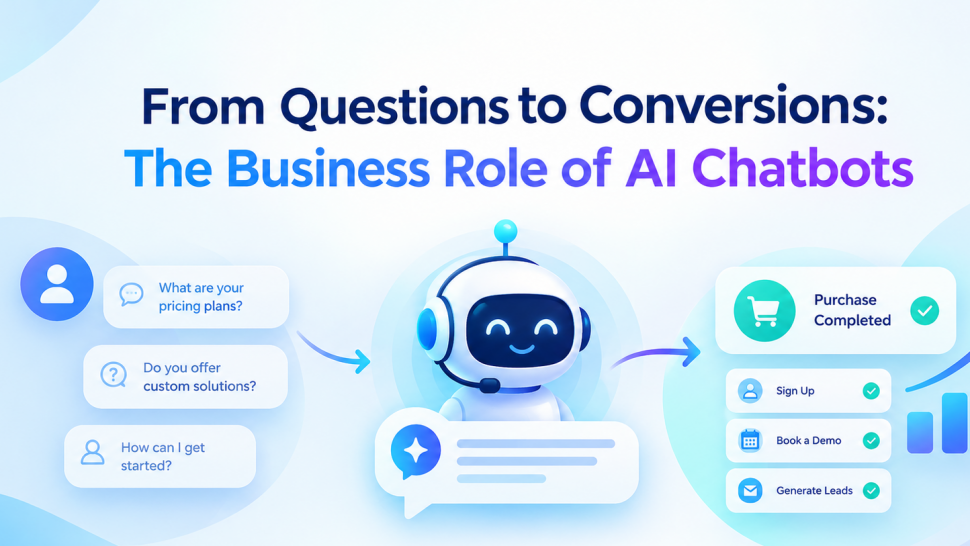

The Business Use of AI Chatbots from Questions to Conversions
Customers do not always progress in a direct path from awareness to purchase. They ask questions, compare options, check prices, look for reassurance, and sometimes leave when they can't get an immediate answer. An AI chatbot is playing a crucial role in today's business strategies, particularly at this critical point.
Instead of being merely passive support mechanisms, AI chatbots can interact with visitors, grasp their purpose, suggest appropriate content, and lead them to the next action. They can be aligned with business objectives and link customer interactions to tangible conversion opportunities.
How AI Chatbots Are Being Used in Modern Businesses
Most of the time, customer support is based on business hours, queues of customer tickets, or responses based on a set template. AI chatbots can interact with users in a conversational manner through websites, mobile apps, messaging apps, and other digital platforms.
They can respond to basic enquiries and provide users with information about products and services, documentation, prices, and account information. This allows for quicker interactions without human teams having to respond to each repetitive query. Businesses that invest in professional AI development services are able to deploy chatbots that integrate seamlessly into their existing digital infrastructure from day one.
The true magic lies in linking conversations with the customer journey, though. A chatbot can determine if the user is in a research or comparison phase, or if they have a higher likelihood of purchasing, and tailor the interactions to suit.
Converting Customer Questions to Opportunities
Often a customer question is loaded with more information than it seems. If they ask about a price, they might be considering a purchase. If a visitor is inquiring about integration, he or she might be evaluating technical compatibility. If the customer asks about delivery, it means that he or she is already very close to committing to the purchase.
Contextual information from conversations can be used by AI chatbots to detect these cues and generate appropriate replies.
For instance, a chatbot on a software company's website might:
- Describe features of the product according to the needs of the visitor
- Make a suitable recommendation for services or plans
- Respond to queries related to integrations and implementation
- Collect basic lead information
- Qualify prospects for a salesperson or consultation
This makes the chatbot more than just a question-and-answer tool — it becomes a connector between customer intention and business action.
A Personalized Customer Experience
Another significant business use case of AI chatbots is personalization. Conversational systems can adapt their responses to the user's question, the previous interactions, the customer data that is available, and the business context, rather than offering the same information to all visitors.
A customer who is returning may require help with their account; a new customer may require an explanation of products or services. Providing the same conversation to both users can lead to unwanted friction.
Using the right data integration, chatbots built through artificial intelligence development services can provide a more relevant experience and assist businesses in delivering a consistent one across channels.
AI Chatbots and Lead Generation
One of the most evident ways an AI chatbot can help businesses grow is by generating leads. The forms on websites may ask for several pieces of information in order to provide the user with assistance. This can be done more naturally with a conversational interface.
A chatbot can initiate a helpful conversation with visitors instead of presenting a lengthy form. It can respond to questions first, then ask for related information when there is a clear need for it. Thoughtful AI chatbot development ensures these conversational flows feel natural rather than transactional.
This can assist businesses in gathering information like:
- Customer requirements
- The services or products that are preferred
- Budget ranges
- Project timelines
- Contact information
The gathered data can then be moved to CRM or sales systems, contingent upon the business's technology stack and data protection requirements.
From the Conversation to the Conversion
Just because a chatbot is present on a website doesn't mean it automatically boosts conversions. It will be effective if the conversation is linked to the following action for the user.
Useful conversion paths may be to book a consultation, get a quote, start a trial, complete a purchase, or contact a sales specialist.
The chatbot should make these actions seem like a natural next step in the conversation, not a sales pitch. That balance can be maintained with clear calls to action, relevant recommendations, and timely human handoffs.
Seamless Integration of AI Chatbots and Business Systems
AI chatbots can integrate with current business systems for more complex applications. The integration enables the chatbot to access or pass information where relevant, rather than being used as a standalone tool.
Common integrations include CRM platforms, knowledge bases, ecommerce systems, ticketing tools, calendar scheduling, and analytics dashboards. Businesses working with experienced AI app development services providers can ensure these integrations are built robustly from the start.
This establishes a wider workflow where a customer can ask a question, get the information they need, share relevant details, and then progress towards an action without having to switch between multiple interfaces.
Assessing the Business Impact
To measure AI chatbot performance, businesses need to look at metrics that tie conversations to real-world results. These metrics can range from conversation completion, qualified leads, appointment bookings, customer satisfaction, response time, escalation rates, conversion rates, and more.
Also watch unsuccessful conversations. When a chatbot repeatedly fails to answer the same questions, loses the same sessions, or has to be escalated to a human multiple times, it is a sign that there is a gap in information or conversational design within the chatbot.
Over time, businesses can enhance their responses and smooth the customer journey by regularly analyzing the data.
Conversational Business Is the Way Forward
AI chatbots are moving from the role of simple automated helpers to becoming intelligent, conversational interfaces capable of assisting in various aspects of marketing, sales, customer service, and commerce.
The best ones will not just seek to answer more questions. They will aim to grasp the reason behind the questions customers are asking and how they can move forward.
For businesses, it's not just automation. It is helping to establish a more agile journey from customer queries to impactful business actions and conversions.



Share the News