

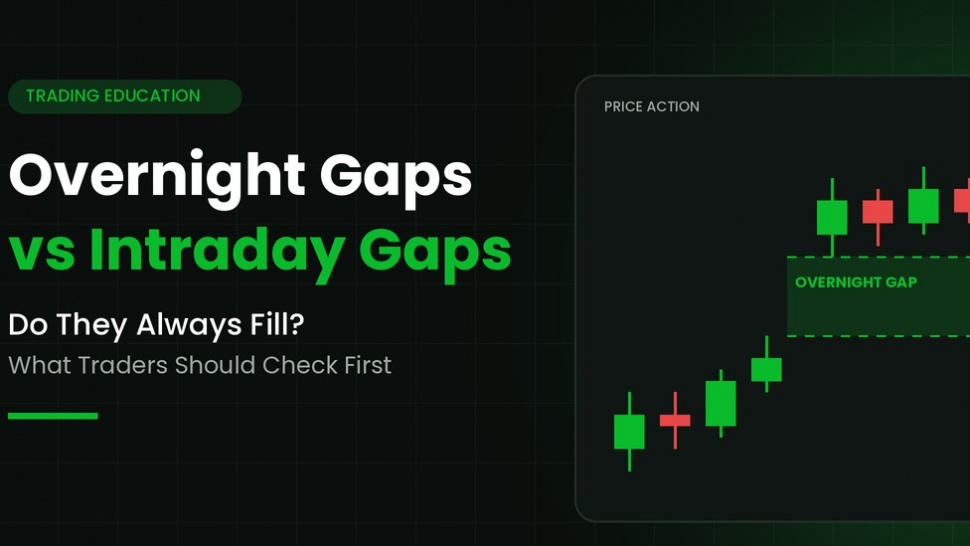

Every trader has seen it. You close your charts at night, and the next morning the price opens far away from where it ended. There is an empty space on the chart, and a familiar voice in your head says, "Gaps always fill."
That saying is one of the oldest in trading. However, it is also one of the most misunderstood. Some gaps fill within minutes. Others stay open for months or even years. So the real question is not whether gaps fill. Instead, it is which gaps fill, and why.
In this guide, we break down overnight gaps vs intraday gaps, explain how each one forms, and walk through the checks experienced traders make before acting on any gap.
What Is a Price Gap?
A price gap is a zone on a chart where no trading took place. It appears when a candle opens above the previous candle's high or below its low. As a result, a visible blank space forms between the two bars.
Gaps happen because supply and demand shift faster than price can trade through each level. When a big piece of news hits, buyers or sellers rush in at once. Price simply jumps to the new level.
Gap Up and Gap Down Explained
There are two basic directions to know. A gap up occurs when the open is higher than the prior high. This usually reflects strong buying interest or positive news. A gap down, on the other hand, occurs when the open is lower than the prior low. It typically reflects fear, selling pressure, or disappointing news.
Understanding gap up and gap down moves is the starting point. Yet direction alone tells you very little. The context behind the gap matters far more.
Overnight Gaps vs Intraday Gaps: The Core Difference
When traders compare overnight gaps vs intraday gaps, the main difference is timing. One forms while the market is closed. The other forms while the market is open. That single difference changes how the gap behaves, how often it fills, and how much risk it carries.
How Overnight Gaps Form
An overnight gap forms between one session's close and the next session's open. During those hours, the regular market is shut. Meanwhile, the world keeps moving.
Earnings reports often come out after the closing bell. Economic data from other regions arrives overnight. Geopolitical headlines can break at any hour. Futures and pre-market sessions start pricing in this information, but many traders cannot act until the open.
So when the opening bell rings, all those orders hit at once. Price jumps to reflect the new information. This is why overnight gaps are often larger and more emotional than other gaps.
How Intraday Gaps Form
Intraday gaps form during the trading session. They are most visible on short timeframes, such as 1-minute or 5-minute charts. Common causes include:
A trading halt that resumes at a very different price
A surprise data release in the middle of the session
A large block order that sweeps through thin liquidity
A sudden headline that hits while markets are already open
Because the market is open, other traders can react right away. Liquidity returns quickly. Consequently, intraday gaps tend to be smaller, and they often fill faster than overnight gaps.
That said, there are exceptions. A trading halt on major news can create an intraday gap that behaves exactly like a strong overnight gap.
Do Gaps Always Fill? The Honest Answer
No, gaps do not always fill. This is the most important lesson in this entire article.
Many gaps do fill. In fact, small gaps in quiet markets fill quite often. But treating every gap as a guaranteed reversal is one of the fastest ways to lose money. A strong gap backed by real news can run for weeks without ever looking back.
The key is learning to separate gaps by type. Technical analysts have long grouped gaps into four categories.
Common Gaps
Common gaps appear in normal, sideways price action. They are usually small and come with average volume. There is no major news behind them. These gaps fill most often, because nothing has truly changed in the market.
Breakaway Gaps
Breakaway gaps happen when price leaves a range or pattern with force. For example, a stock might gap above long-term resistance after strong earnings. These gaps often come with heavy volume. Importantly, they are the gaps least likely to fill quickly. They often mark the start of a new trend.
Runaway (Continuation) Gaps
Runaway gaps appear in the middle of an existing trend. They show that the trend still has strong momentum. Traders who wait for these to fill may miss a large part of the move.
Exhaustion Gaps
Exhaustion gaps occur near the end of a long trend. They feel like a final burst of buying or selling. Soon after, price often reverses and fills the gap. These are tricky, because they can look like runaway gaps in the moment.
In practice, you will only know some gap types for sure in hindsight. That is exactly why the checks below matter so much.
What Traders Should Check First
Over the years, the traders who handle gaps well tend to follow the same routine. They pause before reacting. Then, they run through a short checklist. Here are the five checks that matter most.
1. Identify the News Catalyst
First, ask why the gap happened. Was there an earnings report, a guidance change, or a major economic release? Or did the gap appear with no clear reason?
Gaps driven by real, fundamental news tend to hold. The market is repricing the asset based on new facts. In contrast, gaps with no catalyst often fade as the session goes on.
2. Compare Gap Size to Normal Volatility
Next, measure the gap against the asset's usual range. A helpful tool here is the Average True Range (ATR). If the gap is much larger than the typical daily range, it signals a major shift. Large gaps are less likely to fill on the same day.
Small gaps, by comparison, sit well inside normal movement. Therefore, they are more likely to be absorbed and filled.
3. Watch Volume at the Open
Volume shows conviction. If a gap opens with heavy volume that stays strong in the first hour, buyers or sellers are serious. On the other hand, if volume fades quickly after the open, the gap may lack support.
Many experienced traders avoid acting in the first 15 to 30 minutes. They let the opening rush settle before making a decision.
4. Classify the Gap Type
Then, use the categories above. Is price breaking out of a range? Is it already deep into a trend? Or is it just drifting inside a sideways market? Your answer will shape your expectations for a fill.
5. Map Key Levels
Finally, look at where price gapped to. Did it jump above resistance or below support? Did it land near a prior high, a round number, or a heavy volume zone?
Gaps that clear major levels often keep going. Meanwhile, gaps that run straight into strong resistance may stall and fill.
Understanding Overnight Gap Risks
Overnight gap risks deserve their own section, because they affect every trader who holds positions past the close.
The biggest problem is simple. A stop-loss order cannot protect you while the market is closed. If a stock closes at 50 and opens at 42, a stop at 48 does not fill at 48. Instead, it typically fills near the opening price, which may be far worse than planned. This is known as slippage, and it can turn a small planned loss into a large one.
Several factors increase overnight gap risks:
- Holding positions through earnings reports
- Trading thinly traded stocks or small-cap names
- Holding over weekends, when more news can build up
- Using high leverage on swing trades
So how do experienced traders manage this? First, many reduce position size before major events. Second, some close positions entirely ahead of earnings. Third, others use options to define their maximum loss. None of these methods remove risk completely. However, each one keeps a single bad open from damaging an entire account.
Intraday traders face a different version of this risk. Trading halts can freeze a position mid-session. When trading resumes, price can gap sharply. For this reason, it helps to know which assets are prone to halts.
Common Mistakes Traders Make With Gaps
Even skilled traders slip up with gaps. Here are the errors seen most often.
Fading every gap. Betting against every gap up and gap down because "gaps fill" ignores breakaway and runaway gaps. Over time, this approach can be costly.
Chasing the open. On the other side, some traders buy a gap up the moment the bell rings. Opening prices are often the most volatile of the day. Waiting for confirmation usually leads to better entries.
Ignoring timeframe. A gap on a 5-minute chart has very different meaning than a gap on a daily chart. Keep your analysis consistent with your trading style.
Skipping risk planning. Many traders only think about overnight gap risks after a bad open. Planning ahead is always cheaper than reacting late.
Putting It All Together
To sum up, the debate over overnight gaps vs intraday gaps comes down to time, information, and liquidity. Overnight gaps absorb hours of news at once, so they are often larger and harder to fill. Intraday gaps form while markets are active, so they are usually smaller and fill more readily.
Still, neither type follows a fixed rule. The better approach is to check the catalyst, the size, the volume, the gap type, and the key levels. Then, size your positions with overnight gap risks in mind. Traders who do this consistently treat gaps as information, not as guarantees.
Final Thoughts
Gaps are not magic, and they are not random either. They reflect how quickly markets absorb new information. Once you understand the logic behind overnight gaps vs intraday gaps, you stop asking "Will it fill?" and start asking "What is this gap telling me?" That shift alone can improve your decision-making. Many traders also use charting tools and indicators, such as those from GainzAlgo, to help spot gaps and key levels more quickly. If you find yourself asking "is GainzAlgo legit" or wondering about any other trading tool, apply the same discipline you would use on a gap: review its methodology, test it on historical and demo data, and never rely on any single signal without proper risk management.



Share the News