

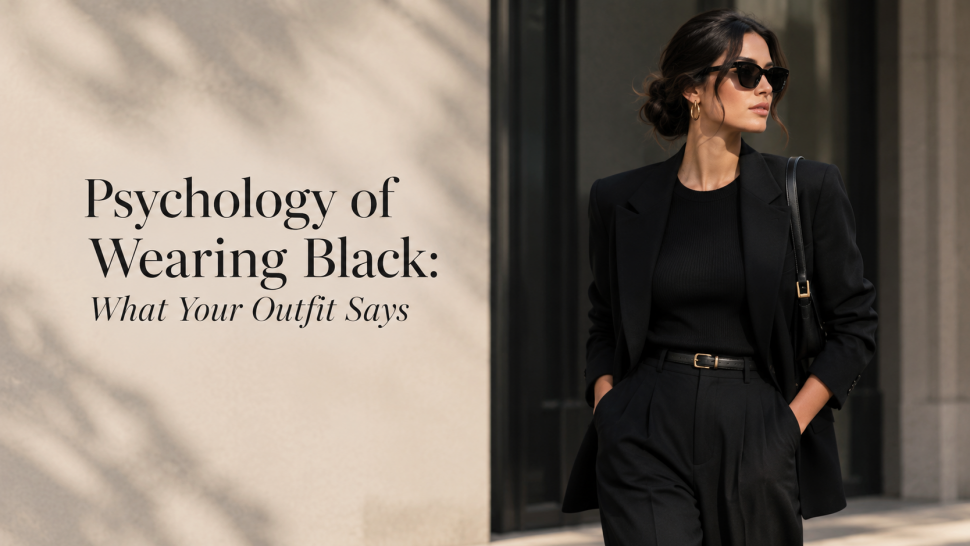

The psychology of wearing black combines cultural symbolism, social perception, and the way clothing shapes the wearer's own mindset. Black signals authority and polish to others, and it often helps the wearer feel more composed. Few people can say why they keep reaching for it, so this guide covers what research and fashion history say, and how to use black on purpose.
Quick answer: The psychology of wearing black comes down to three things: it signals authority and seriousness, it simplifies decisions, and it carries strong cultural meaning, from formality to mourning to rebellion. Research on color and clothing shows the effect depends on context, so black reads as powerful in one setting and somber in another.
What Is the Psychology of Wearing Black?
It is the study of how black clothing shapes the way others judge you and the way you feel while wearing it. Black carries layered meanings: authority, formality, mystery, mourning, and rebellion. Which meaning wins depends on the setting, the garment, and the person wearing it.
Psychologists Andrew Elliot and Markus Maier reviewed the field of color psychology in the Annual Review of Psychology in 2014. They describe color effects as dependent on context rather than universal rules, which is the right lens for black. The same coat reads differently at a funeral, a board meeting, and a concert.
Why Do So Many People Wear Black?
People wear black for three main reasons: it is versatile, it has a strong cultural and fashion history, and it removes decisions from the morning routine.
Is it because black goes with everything?
Yes, partly. Black pairs with nearly every other color, so building an outfit takes less effort. A black base also lets one piece, such as a red scarf or a cream knit, carry the whole look.
How did fashion history make black a default?
Three moments stand out:
1861 onward: After Prince Albert died, Queen Victoria wore black for the rest of her life, reinforcing black as the color of mourning in Britain.
1926: Vogue published a sketch of a Chanel black dress and compared it to the Ford car, predicting it would become a kind of uniform for women of every background. The little black dress became a wardrobe standard.
1953: Marlon Brando wore a black leather jacket in The Wild One, tying black leather to rebellion for generations of viewers.
Johnny Cash later gave the color a moral voice with his 1971 song "Man in Black."
Does black simplify daily decisions?
Yes. A narrow, repeatable palette means fewer outfit choices. Steve Jobs's black Issey Miyake turtleneck is the best-known example of a personal uniform. The practical tip: if you want this benefit, pick one silhouette you like and buy it in black, rather than collecting many different black items.
What Does Wearing Black Say About Your Personality?
Most observers read black as serious, polished, and confident, and sometimes as reserved or mysterious. That is a perception, not a diagnosis. People choose black for many reasons, including practicality, budget, and plain preference.
The common mistake is reading someone's mood or character from their wardrobe. A better question is what a person wants the outfit to do: look professional, blend in, or feel protected. Texture is where personality shows. A black outfit built from leather, wool, and silk says something different from one built from a single flat fabric.
Does Wearing Black Change How Others See You?
Yes. Black changes first impressions, often toward authority and formality, and sometimes toward intimidation.
The clearest evidence comes from a 1988 study by Mark Frank and Thomas Gilovich in the Journal of Personality and Social Psychology. They found that professional football and hockey teams in black uniforms drew more penalties than other teams. In a follow-up experiment, referees who watched staged plays judged the same actions more harshly when the team wore black.
The practical takeaway: black adds weight to your presence. For an interview or presentation, that helps. For a first conversation where you want to seem approachable, add a lighter layer or a warm accessory.
Does Wearing Black Affect How You Feel?
It can. Psychologists call the mechanism enclothed cognition: the meaning you attach to a garment influences your thinking and behavior.
Hajo Adam and Adam Galinsky tested this in a 2012 paper in the Journal of Experimental Social Psychology. Participants who wore a white coat described as a doctor's coat did better on an attention task than those who wore the same coat described as a painter's coat. That study did not test black clothing, so it does not prove black boosts confidence. It does show that what an outfit means to you matters. If black makes you feel composed, that is a legitimate reason to wear it before a hard day.
Why Is Black Linked to Confidence, Power, and Elegance?
Black earned these associations through repeated use in settings that signal status and seriousness. Evening wear, tuxedos, luxury packaging, and the robes worn in many courtrooms and academic ceremonies all rely on black to convey formality.
There is also a visual reason. Black creates strong contrast with lighter colors and skin tones, which makes outlines look sharp and deliberate. Elegance in black usually comes from fit and fabric rather than decoration, which is why a well-cut black piece looks expensive even when it is simple.
Is Wearing Black Every Day a Bad Sign?
No. Wearing black every day is not, on its own, a sign of anything. Clothing choice alone is not a reliable indicator of mood or mental health, and most people who wear mostly black do it for style or convenience.
If a change in how you dress comes with weeks of low mood or withdrawal, that is worth raising with a doctor or counselor, but the color is not the signal. If your all-black wardrobe feels flat, add variety through fabric and fit instead of changing the palette.
Why Is a Black Leather Jacket Such a Lasting Style Staple?
A black leather jacket combines black's authority with leather's rebellious history and long life. Schott introduced the Perfecto jacket in 1928, and Brando's 1953 appearance in The Wild One turned it into a cultural symbol.
It also works in nearly every season and setting. A black leather jacket over a white tee and jeans looks casual, and over a dress it looks sharp. If you are looking for a place to start, a well-fitted pair of women's black leather jackets shows how much range one piece can have, from cropped biker cuts to longer, softer silhouettes.
How Can You Style Black for Different Moods and Settings?
Start with the effect you want, then choose the pieces. Here is a simple way to do it:
For authority at work: wear a tailored black blazer or structured jacket with one lighter piece underneath.
For relaxed confidence: pair a black tee, straight jeans, and a black leather jacket.
For an evening out: choose a black dress or trousers and add texture, such as satin, suede, or leather.
To soften the look: add one warm color, such as tan boots, a cream knit, or gold jewelry.
To avoid a flat look: mix fabrics. Leather, wool, cotton, and silk reflect light differently and add depth to an all-black outfit.
How does black compare with white and navy?
The meanings below are common Western associations. They shift across cultures.
Color Common perceived meaning Best occasions
Black Authority, formality, mystery, edge Evening events, presentations, creative work, leather outerwear
White Cleanliness, simplicity, openness Summer wear, minimalist looks, clinical or service settings
Navy Trust, reliability, approachable authority Interviews, client meetings, daily office wear
FAQs
Why do people wear black?
People wear black because it is versatile, formal, and easy to style, and because it carries cultural meanings of authority, elegance, and rebellion. Many also choose it to simplify daily outfit decisions. The reason varies by person, so black reflects preference and context more than any single personality trait.
What does wearing black say about you?
Most observers read black as serious, polished, and confident. It can also read as mysterious or reserved. These are perceptions, not facts about character. The same black outfit can look formal at a business meeting and edgy at a concert, so context shapes the message more than the color alone.
Does black make you look more authoritative?
Often, yes. Black is tied to formal wear, uniforms, and professional dress, so many people associate it with authority. In the 1988 Frank and Gilovich study, black uniforms were also judged as more aggressive, so authority can tip into intimidation. For a softer look, pair black with lighter pieces or warm accessories.
Is black always the color of mourning?
No. Black is the traditional mourning color in much of Europe and North America, a custom reinforced in Britain by Queen Victoria after 1861. In parts of East Asia, white has traditionally been associated with mourning. Cultural context decides what black means, which matters if you dress for an international audience.
Can wearing black improve your mood or confidence?
It can for some people, through a mechanism psychologists call enclothed cognition: the meaning you attach to a garment influences your thinking and behavior. Adam and Galinsky demonstrated this in 2012 using a lab coat, not black clothing. If black makes you feel composed, that feeling is worth using.
How do you wear black without looking severe?
Mix textures and break up the black with one lighter or warmer piece, such as a cream knit, tan boots, or gold jewelry. Leather, wool, cotton, and silk reflect light differently, which adds depth. A relaxed fit also softens the look compared with sharp tailoring in head-to-toe black.
Conclusion
The psychology of wearing black rests on three ideas: black signals authority and polish, it can shift how you feel through the meaning you give it, and its message changes with context and culture. It is neither a mood indicator nor a rule, just a strong tool.
Your next step: before you get dressed, decide what you want the outfit to say, then use black deliberately, with one contrasting piece, mixed textures, and a fit that suits the setting. If you want a strong black piece to build around, explore the outerwear at Jackets Junction.



Share the News