

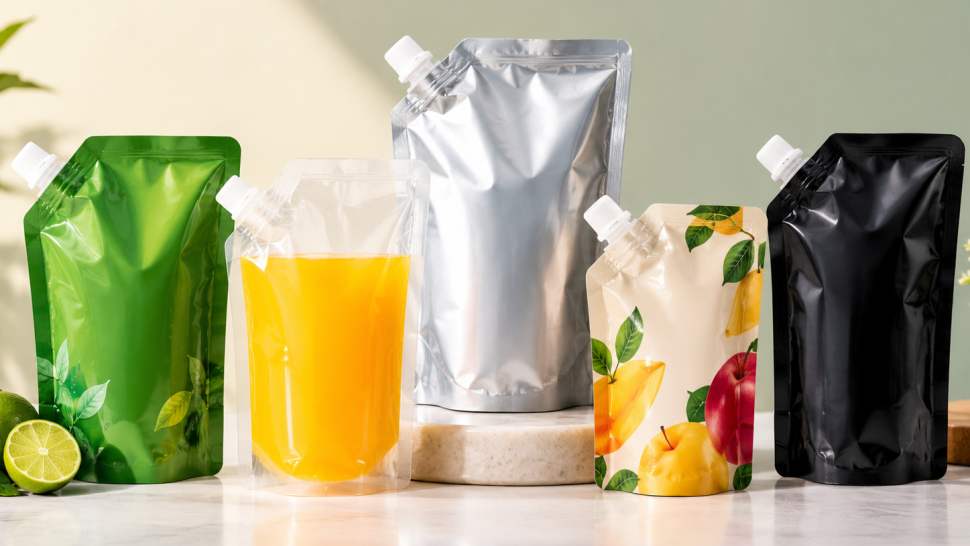

Visit any grocery store and you will find soft stand up packages with a small top cap. Customers squeeze them, pour off of them and stuff them into lunch bags. These spout pouches are now carrying juice, baby food, sauces and soap. They are as light as a bag and easy to pour like a bottle, and that is why every year more and more brands switch to them.
What is a Pouch with a Spout and how does it work?
A spouted pouch consists of three components: a flexible body, a plastic fitment, and a cap. The product is held by the body and it is covered by layers of film within the body to keep it away from air and light. The fitment welds on the top or corner of the pouch and forms a tight opening. The cap screws on after filling, and therefore, the customer can reopen the pouch and reseal the cap a number of times. The bottom has a gusset to allow the pouch to stand upright on a shelf and enable the shopper to see the front panel clearly.
What Do Factories do to construct these pouches?
The spout pouches are constructed by the manufacturers following a series of steps and each step influences the quality of the final product. The artwork is printed by machines, bonded, cut and welded by the machines. Each batch is then inspected by workers prior to shipping.
Printing and Lamination
The design is then printed on a clear film of polyester or nylon by presses. That film is then bonded by a laminator to a sealing layer, frequently polyethylene, and occasionally a layer of aluminum foil is added to provide further barrier. The majority of the completed films are 100 to 150 microns thick. Thicker films are less prone to leaks; however, they are more expensive and are stiffer.
Forming and Spout Welding.
A pouch machine cuts the film, folds the bottom gusset and seals the sides. An ultrasonic or heat welder is then used to weld the spout to its opening. This weld shall remain tight, as a loose joint results in the majority of the leaks. Each type of film has operator control of heat, pressure, and time.
Checking and Quality Tests.
Technicians press samples, drop them from predetermined heights and fill them with water to seek leaks. They also require pulling seals to gauge strength. Good factories do not only test the initial production run, but all production runs as machine settings change with time.
In Which Everyday Places Are They Used?
Most people are unaware of the locations where they use spout pouches. The format was popularized by fruit purees aimed at kids and was followed by drink makers and sauce brands and cleaning companies. The pouch can be used with virtually any pourable product, such as thin liquids and thick gels. Common uses include:
• Pureed baby food and fruit purees.
• Sauces, cooking oils and honey.
• Soap refills, laundry soap refills and body gels.
Pouches vs. Bottles and Jars:
Spout pouches prevail over inflexible vessels in terms of weight, space and shipping cost. A typical filled pouch will weigh 60 to 80 percent less than a similar bottle. Flat shipping is also done with empty pouches, meaning that a pallet with many packages is much heavier than a pallet with empty bottles.
According to various industry reports, flexible packaging is estimated to be approximately 15 to 20 percent of the global packaging market and the spouted format increases approximately 5 to 7 percent annually. In certain instances, rigid containers prevail. Glass jars are heat-sterilized and feel high-end, and sticky goods can stick to the folds of a pouch. A number of brands balance these trade-offs and employ both formats.
What Do Buyers Need to Know Before They Place an order of Spout Pouches Wholesale and a Packaging Budget?
Big orders alter the equations. Spout Pouches Wholesale programs decrease the cost per unit and 20 percent and 40 percent discounts are common with increases in quantity, from thousands to hundreds of thousands. Digital printing typically begins with a minimum of 1,000, whereas rotogravure printing may demand as many as 10,000. Lead times take three to eight weeks, depending on the printing method and the option of fitment. Purchasers are advised to verify a sample, do a filling trial, and verify film and cap information in writing before committing to a complete run.
Why Factory-Direct Production Matters?
When a brand collaborates with the company that produces the pouch, it communicates with people who operate the machines. Companies like Kwick Packaging can print, laminate and form under the same roof and hence can rectify an issue at the origin. Such an arrangement reduces the feedback cycle. The production floor responds to a buyer requesting a fatter film or a new cap rather than a series of messages.
The USA Leading Packaging Brands: Kwick Packaging and ProAmpac.
The US flexible packaging market is influenced by several companies. All of them come with a set of varied strengths, and customers must align the brand with the size and objectives of their project.
Growing Brand Custom Pouches.
The former brand has its own production facility where they produce pouches, mylar bags, and printed flexible packaging. It also caters to the needs of small and mid-size enterprises desiring custom sizes, shorter runs, and proximity to the team that designs their order.
ProAmpac: A wide flexible offering.
ProAmpac is a Cincinnati, Ohio-based company that provides a variety of flexible formats for food and consumer brands. Its line includes pouches, films, and specialty packaging in a variety of products.
Is it possible to make Pouches Greener?
A lot of pouches have mixed layers that cannot be recycled by curbside programs. It is common to find in surveys that over 50% of the shoppers favor packaging that is environmentally friendly, and thus factories are currently testing polyethylene films that use mono-materials and favor store drop-off schemes. Light packaging also reduces transport emissions and refill pouches ensure that fewer bottles go into landfills. Any new film that buyers want to use must also be tested, as certain recyclable structures are less resistant to oxygen.
Final Thought
Flexible packaging continues to increase due to its ability to address actual issues. A pouch having a spout will save on material and pack light, flow well and cap for daily use. Brands that are compatible with the correct film, fitment, and shape for their product do not leak, waste stock or have dissatisfied customers.
Educated customers acquire knowledge in the fundamentals. They inquire about film layers, sample with actual product, and compare makers prior to making an order. Spout pouches compensate for such attention, as small decisions regarding film, fitment, and size determine the success of a package on the shelf and in the hands of the customer.



Share the News