

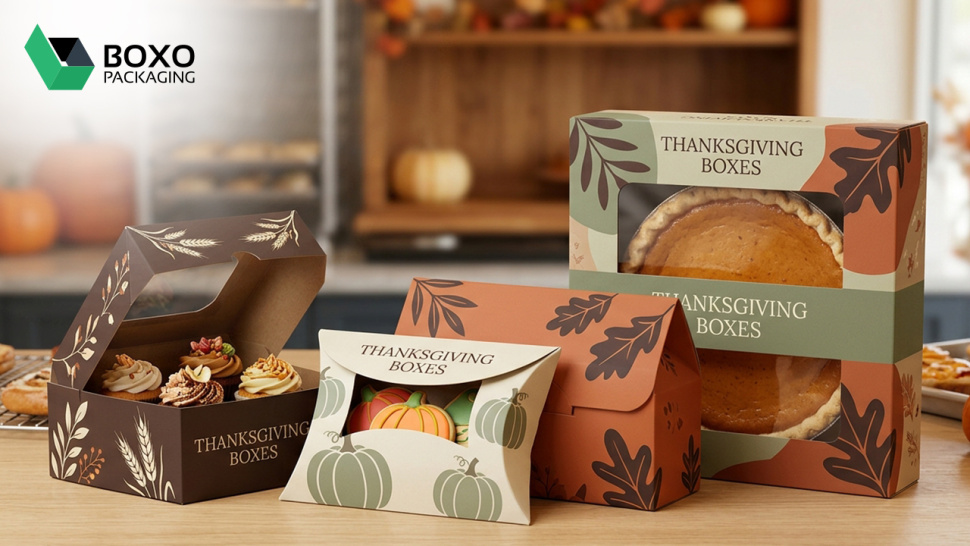

The correct starting point is the actual food or gift assortment, including any inner containers and serving accessories. For Custom Thanksgiving Boxes, seasonal artwork comes after the decisions about contact materials, product arrangement, and handling. A decorative carton for wrapped treats has different requirements from a container touching moist or fatty food.
For U.S. food-contact applications, intended use matters. FDA guidance covers packaging components such as adhesives and colorants, and paperboard provisions distinguish food types and use conditions. A seasonal print does not establish that a material is suitable for the food being packed.
Separate the keepsake idea from the food-contact job
Picture a bakery preparing a host gift with wrapped shortbread, a sealed jar of preserve, and a small serving card. An outer gift carton can present the assortment, while the primary packages contain the food. The jar still needs support so it cannot knock into the biscuits.
Now replace those items with an unwrapped slice of a rich dessert. The contact surface, grease exposure, temperature, and holding period need a separate assessment. Do not reuse the gift-carton specification just because the portion fits inside it.
Before selecting the seasonal carton, confirm these details:
- Identify which surfaces will actually touch the food.
- Record whether the contents enter the package warm or cooled.
- Include the dimensions of jars, wraps, and protective liners.
- Decide whether customers carry the assortment flat or upright.
Bakery trays, food-contact liners, and partitioned inserts can each address specific needs, but their suitability must be verified. A decorative outer box is not a substitute for a correctly specified inner tray.
Keep a short seasonal message separate from essential details
Autumn illustrations can make a host gift recognizable without covering every panel. Leave space for the product information that recipients need after the holiday gathering, including ingredient or storage information where applicable. Decorative leaves should not make small text difficult to read.
The same approach helps manage inventory. A neutral structural carton with a seasonal sleeve may suit a business whose assortment changes close to the holiday. A fully printed holiday carton may suit a stable, planned offering. Compare the actual order and packing arrangement rather than treating one approach as universally better.
Discussing the complete assortment with Boxo Packaging gives the structural brief a concrete starting point. Bring the wrapped shortbread and filled jar, not just their nominal weights. Ask whether an insert and the outer carton can be sampled together.
For Custom Thanksgiving Boxes, the final approval should involve packing the real gift and lifting it as a recipient would. If the jar moves or the lid presses against the serving card, revise the structure before approving the print. The closure is the next detail worth examining closely.
Custom Tuck Boxes with Closures Matched to the Contents
A tuck-end carton closes when a main flap folds over smaller dust flaps and its tongue fits inside the carton body. With Custom Tuck Boxes, the main flaps may close in the same direction or in opposite directions, depending on the selected structure. A glued side seam commonly forms the carton body. The construction is familiar in small retail packs, but familiarity does not guarantee suitability for every gift. The closure needs to tolerate the actual packing process and contents without springing open or becoming difficult to reopen.
Choose flap orientation before placing the artwork
Straight tuck-end and reverse tuck-end cartons differ in the direction of their main closing flaps. In the straight version, both close toward the same side; in the reverse version, they close toward opposite sides. Confirm the cutting guide rather than interpreting the name as a promise of strength.
Flap orientation affects which panel receives the opening edge and how operators close the package. It can also influence where a seam or closure interrupts the artwork. Review a folded dummy while deciding which face will point toward the shopper.
The prototype should pass these four checks:
- Dust flaps should fold inward without catching the contents.
- The tuck tongue should enter without crushing its corners.
- The closed bottom should support the intended filled package.
- The recipient should find the opening without tearing a display panel.
For a small boxed spice blend supplied in a sealed sachet, a tuck carton may provide straightforward retail presentation. A glass bottle or heavy jar may require another base construction, an insert, or a different carton altogether. Test the load rather than relying on the style name.
Build the packing routine into the specification
A carton that works once can still be frustrating in repeated assembly. Check whether operators can square the body, close the base, load the product, and finish the top without an awkward grip. Small dimensions and stiff flaps can change that sequence considerably.
Compare related folding cartons using a filled sample. An auto-bottom carton changes base assembly, while a sleeve and tray changes product access. Display cartons solve yet another problem by holding several sale units together. These alternatives deserve consideration when a conventional tuck closure feels forced.
The useful specification for Custom Tuck Boxes describes the item, the preferred opening face, the closure arrangement, and any retention requirement. Applied to a holiday gift, that discipline keeps the seasonal decoration separate from the mechanical work of holding everything together.



Share the News