

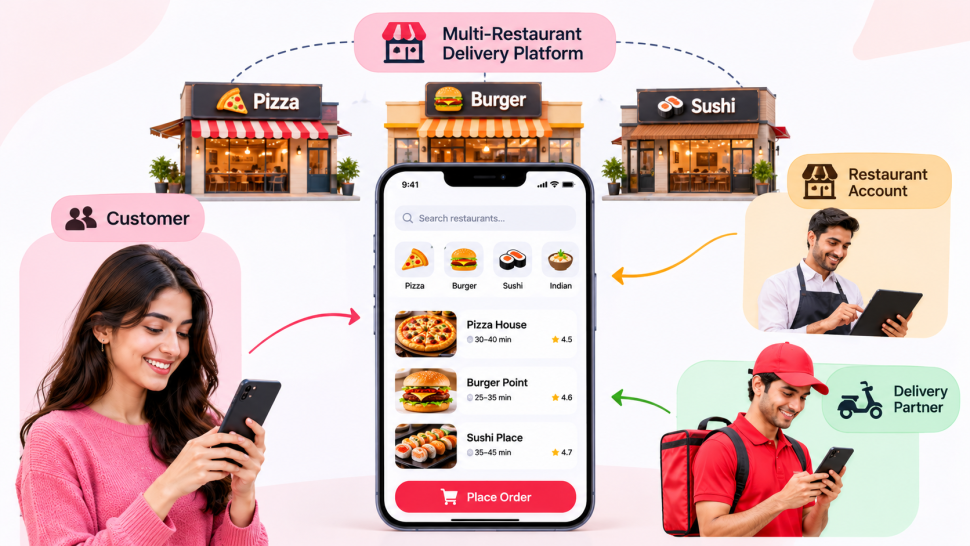

Online food delivery has evolved beyond individual restaurant ordering applications. Customers increasingly expect to browse multiple restaurants, compare menus, place orders, track deliveries, and make payments through a single platform. This has created opportunities for entrepreneurs, restaurant groups, and food-tech businesses to launch multi-restaurant delivery marketplaces.
Unlike a basic food ordering app, a multi-restaurant platform must coordinate several businesses and their operations. Restaurants need independent accounts to manage menus, prices, availability, and incoming orders. Customers need a convenient way to discover restaurants and place orders, while delivery partners require tools to accept assignments, navigate routes, and update delivery statuses.
The platform owner also needs a central administrative system to manage restaurants, commissions, payments, promotions, customer accounts, and operational performance. All these components must work together to provide a consistent ordering experience.
Building such a platform requires careful planning and suitable technology. Businesses can choose custom development, white-label software, clone-based applications, or existing source code that can be customized. The right approach depends on the expected number of restaurants, delivery model, launch budget, and long-term expansion plans.
The following five companies offer different options for businesses planning to build a multi-restaurant food delivery platform.
1. Triple Minds
Triple Minds offers food delivery app development services for businesses planning to launch their own restaurant ordering and delivery platforms. Its solutions are relevant to food-tech startups, restaurant aggregators, entrepreneurs, and established businesses looking to build a branded multi-restaurant marketplace.
A multi-restaurant delivery platform requires several connected applications. Customers need a convenient interface for discovering restaurants, browsing menus, placing orders, and tracking deliveries. Restaurant partners need a dedicated system for managing their menus and processing incoming orders. Delivery partners require tools to receive assignments and update delivery progress, while platform administrators need centralized control over the entire marketplace.
Triple Minds provides custom and white-label food delivery development options that can support these different operational roles. A business can plan its product around customer, restaurant, delivery partner, and administrator workflows rather than relying on a single application for every user.
Important capabilities to consider include restaurant registration, menu management, real-time order updates, payment integration, delivery tracking, commission management, and promotional tools. These functions help platform owners coordinate multiple restaurants while maintaining a consistent customer experience.
Another important consideration is scalability. A startup may initially onboard a small number of restaurants in one area, but its requirements can change as it expands into additional locations. The platform may need to support more restaurant partners, different delivery zones, additional payment methods, and more complex commission arrangements.
Triple Minds can be considered by businesses that want to discuss these requirements as part of a custom or white-label development project. The exact feature scope, integrations, ownership terms, and ongoing maintenance arrangements should be confirmed before development begins.
Best For: Food-tech startups, restaurant aggregators, and entrepreneurs seeking custom or white-label multi-restaurant delivery app development.
2. Burj Code
Burj Code is a Dubai-based technology company offering mobile application development, e-commerce solutions, and custom software engineering. Its broader development capabilities make it relevant to businesses planning to build a multi-restaurant food delivery marketplace.
A platform serving multiple restaurants needs more than a customer-facing ordering interface. It must coordinate restaurant operations, product availability, payments, delivery assignments, and administrative processes. Custom development can help businesses design these workflows around their operating model.
Burj Code's application development services can support the creation of separate experiences for customers, restaurant partners, delivery personnel, and platform administrators. For example, restaurant partners may need dashboards to update menu items, manage prices, accept orders, and monitor preparation status. Customers need restaurant discovery, product browsing, checkout, and order tracking. Delivery personnel require access to assigned orders and delivery information.
The company also provides broader digital services, including backend development, UI/UX design, cloud-related engineering, and digital growth support. These capabilities can be useful when a food delivery business needs to connect its application with payment providers, maps, notification services, or existing business systems.
A custom platform can also accommodate different business models. A company may operate its own delivery fleet, allow restaurants to manage their deliveries, or use a combination of both. These decisions influence driver management, delivery charges, order assignment, and administrative controls.
Before selecting a development scope, businesses should discuss multi-restaurant onboarding, commission calculations, restaurant-specific menus, delivery-zone management, payment processing, and reporting. They should also clarify how the application will handle increasing order volumes and additional restaurant locations.
Best For: Businesses seeking custom mobile and backend development for a multi-restaurant delivery marketplace with room for operational customization.
3. Sell My Code
Sell My Code offers a marketplace-based approach for businesses interested in purchasing existing software and application source code. For entrepreneurs planning a multi-restaurant delivery platform, this can provide an alternative to commissioning every component of the application from the beginning.
An existing food delivery codebase may offer a starting structure for common features such as customer registration, restaurant listings, menu browsing, shopping carts, order placement, and payment integration. Depending on the available product, it may also include restaurant dashboards, delivery partner applications, and administrative controls.
This approach can be attractive to startups that want to evaluate existing technology before making a larger development investment. However, the suitability of a source-code product depends on how closely its functionality matches the intended business model.
A multi-restaurant marketplace has requirements that may not be covered by a basic single-restaurant ordering application. The platform may need independent restaurant accounts, separate menus and pricing, commission settings, restaurant approval workflows, delivery-zone management, and centralized reporting.
Businesses should therefore review the product carefully before purchasing. Important areas include the technology stack, code quality, documentation, licensing conditions, third-party dependencies, update history, and available customization options.
It is also important to understand that buying source code does not automatically provide a fully operational delivery business. The buyer may still need developers to customize the application, configure hosting, integrate payment gateways, connect mapping services, and test the complete ordering process.
The availability of a suitable multi-restaurant food delivery product should be confirmed directly through the marketplace. If an appropriate codebase is available, businesses can compare the total purchase and customization cost with a custom development project.
Best For: Entrepreneurs and software businesses interested in evaluating existing source code as a foundation for a multi-restaurant delivery platform.
4. Make An App Like
Make An App Like focuses on clone-based and ready-made application solutions for businesses that want to launch digital platforms using familiar product structures. Its approach can be relevant to entrepreneurs exploring a food delivery marketplace inspired by established services.
A clone-based application can provide a starting framework for common food ordering features. Depending on the selected product, this may include customer registration, restaurant listings, menu management, order placement, online payments, delivery tracking, and administrative controls.
For a multi-restaurant business, the most important consideration is whether the solution supports independent restaurant operations. Each restaurant should be able to manage its own menu, pricing, availability, incoming orders, and business information. The platform owner should retain centralized control over onboarding, commissions, promotions, and marketplace settings.
Businesses should also examine how the solution handles delivery operations. Some platforms allow restaurants to manage their own deliveries, while others provide a separate delivery partner application and centralized order assignment. The choice can affect the platform's operating costs and the level of control available to the business owner.
Make An App Like can be considered by entrepreneurs who want to explore a clone-based starting point rather than developing all application components from scratch. However, the exact features included in the selected solution should be confirmed through a product demonstration.
Businesses should ask about multi-vendor support, restaurant dashboards, driver management, payment integration, source-code access, customization rights, and ongoing maintenance. If the initial product is designed for a single restaurant, additional development may be necessary before it can support a marketplace model.
Best For: Entrepreneurs exploring clone-based or ready-made food delivery applications that can be customized for a multi-restaurant business.
5. Prebuild Apps
Prebuild Apps is another option for businesses investigating prebuilt application software. This approach may appeal to entrepreneurs who want to evaluate existing products before investing in a fully custom multi-restaurant delivery platform.
Prebuilt applications can reduce initial development work when their existing functionality closely matches the intended business model. However, a multi-restaurant marketplace has requirements that go beyond those of a basic restaurant ordering application.
A suitable solution should support multiple restaurant accounts, individual menus, product availability, order management, customer accounts, payment processing, and delivery workflows. The platform owner may also need restaurant approval controls, commission management, promotional campaigns, and performance reports.
Businesses considering Prebuild Apps should confirm whether its current catalogue includes a product specifically designed for multi-restaurant delivery. A demonstration can help establish whether restaurant partners can manage their own operations and whether administrators can oversee the complete marketplace.
Customization is another important consideration. A business may want different delivery charges for different locations, restaurant-specific commissions, custom payment integrations, or separate delivery arrangements. It should understand which features can be configured and which require additional development.
Before choosing a prebuilt solution, businesses should also clarify source-code access, licensing terms, hosting requirements, deployment responsibilities, and post-launch support. A product that appears affordable initially may require substantial customization to support the intended business model.
Best For: Entrepreneurs exploring prebuilt food delivery software and looking to assess whether an existing application can support multi-restaurant operations.
What Should Businesses Look for in a Multi-Restaurant Delivery App Development Company?
The right development partner depends on the size of the marketplace, its delivery model, and the number of restaurant partners it expects to onboard. A platform operating in one city may have different requirements from a business planning to expand across multiple regions.
Before selecting a provider, evaluate these important capabilities:
Restaurant onboarding: Restaurants should be able to register, submit business information, and manage their profiles through dedicated accounts.
Menu management: Restaurant partners need tools to add products, update prices, manage availability, and organize menu categories.
Order management: The system should coordinate order placement, restaurant acceptance, preparation, dispatch, and delivery updates.
Delivery operations: Confirm whether the platform supports an independent driver app, restaurant-managed delivery, or both.
Payment and commission management: The platform should support suitable payment methods, delivery charges, refunds, and restaurant commission calculations.
Real-time tracking: Customers should be able to monitor order progress and, where applicable, follow the delivery partner's location.
Administrative controls: Platform owners need tools to manage restaurants, customers, drivers, promotions, transactions, and reports.
Scalability: The application should be planned to accommodate additional restaurants, locations, users, and order volumes.
It is also important to request a working demonstration and a detailed project proposal. These help businesses distinguish between features already included in a product and those that require customization.
Conclusion
Building a multi-restaurant delivery platform requires a coordinated system for customers, restaurants, delivery partners, and administrators. The right technology can help businesses manage restaurant onboarding, organize menus, process orders, coordinate deliveries, and expand their marketplace operations.
Triple Minds and Burj Code offer development routes for businesses considering custom or white-label applications. Sell My Code provides a marketplace approach for evaluating existing source code, while Make An App Like and Prebuild Apps are options to investigate for clone-based or prebuilt software.
The best choice depends on the business model, development budget, customization requirements, and long-term expansion plans.
Before committing, confirm the available features, technical architecture, integrations, ownership terms, and maintenance responsibilities. A clear project scope will help ensure that the selected platform can support the business as its restaurant network and customer base grow.



Share the News