


Wellness advice comes from everywhere: podcasts, influencers, group chats, supplement labels, even well-meaning relatives. Some of it is sound. Some is expensive guesswork. The hard part is telling the two apart before you change your diet, buy a product, or skip a doctor’s visit.
Your own data can help. Lab results, wearable trends, and AI blood work analysis show whether a claim fits your body instead of an average stranger’s. But data answers only half the question. You also need a way to judge the advice itself. Here is a practical method.
Why Wellness Advice Is So Hard to Judge
Confidence is not evidence. A person can sound certain and be wrong. Several things make this worse:
- Headlines overstate studies. A small trial or a mouse experiment becomes “science proves.”
- Incentives are hidden. Many advice-givers earn money from products, programs, or affiliate links.
- Advice gets stripped of context. A dose that helped one group may not suit you.
Two real cases show the cost. In 2018, Goop agreed to pay $145,000 in civil penalties to settle a case brought by California prosecutors over unsupported marketing claims for some of its products. And Theranos promised dozens of tests from a few drops of blood. Its founder, Elizabeth Holmes, was convicted of fraud in 2022. Polished branding and big promises were not proof of anything.
Red Flags to Watch For
- Claims of a “cure” for many unrelated conditions
- Language like “doctors don’t want you to know”
- Only testimonials, with no study cited
- Pressure to buy now or buy a bundle
- No mention of side effects, risks, or who should avoid it
- Advice to stop prescribed medication
- Fear-based messaging about “toxins” without naming specific ones
One red flag doesn’t prove bad advice. Several together should make you stop and check.
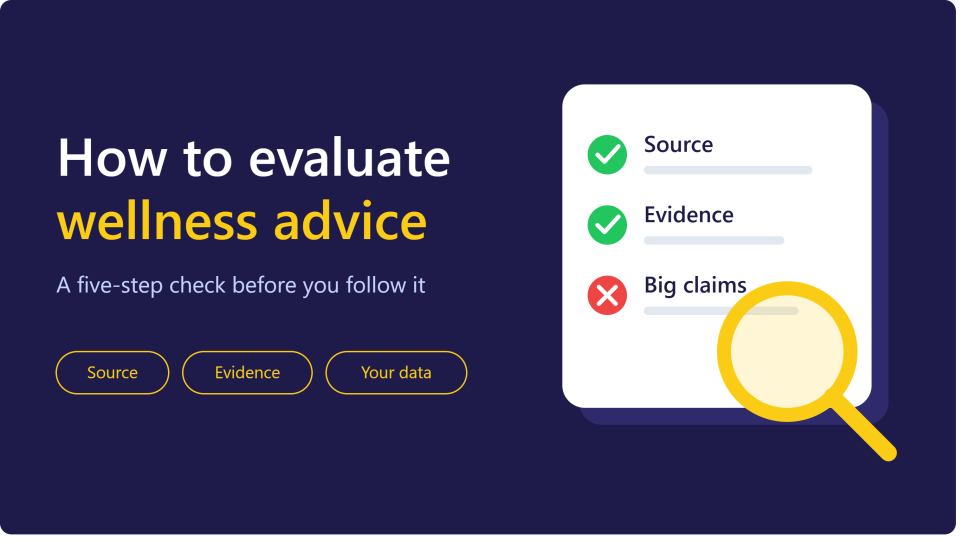
A Five-Step Check Before You Act
- Identify the source and what they gain. Look for credentials, disclosures, and whether they sell something. A financial interest doesn’t make advice wrong, but it calls for more scrutiny.
- Check the type of evidence. Roughly from strongest to weakest: systematic reviews and randomized trials in people, observational studies, animal or cell studies, then personal stories. Most viral claims rest on the bottom tiers.
- See whether it applies to you. Look at the age, sex, health status, and dose in the research. Results in healthy young men may not carry over to you.
- Weigh the risks and costs. Consider side effects, drug interactions, and money. A low-risk change like a daily walk needs less proof than a high-dose supplement.
- Test it on yourself. Change one thing, track it for four to eight weeks, and compare your numbers before and after.
Where to Verify Claims
You don’t need to read every paper. These sources help:
- PubMed: a searchable index of medical research
- ClinicalTrials.gov: shows what trials exist and what they found
- NIH Office of Dietary Supplements: fact sheets on vitamins and supplements
- MedlinePlus: plain-language health information from the National Library of Medicine
- FDA and FTC: warning letters and enforcement actions on misleading claims
One important point: the FDA does not approve dietary supplements for safety or effectiveness before they are sold. Label claims are not a stamp of approval.
Use Your Own Data as a Reality Check
Advice about averages is only a starting point. Your numbers tell you what applies to you.
Baseline labs: lipids, ApoB, fasting glucose, HbA1c, hs-CRP, vitamin D, and thyroid markers where relevant
Wearable trends: resting heart rate, heart rate variability, sleep duration, and activity
Repeat testing: retest after a consistent trial, usually three to six months for bloodwork
If someone recommends high-dose vitamin D, check your level first. If a protocol promises better sleep, see whether your sleep data moves. If nothing shifts, the advice may not work for you.
Keep the limits in mind. Wearables estimate many metrics rather than measure them precisely. Labs vary with fasting, hydration, and timing. Look at trends over time, not single readings.
How Bad Advice Can Backfire
- Supplement interactions: St. John’s wort can weaken some medications, including certain birth control pills and blood thinners.
- Lab interference: The FDA has warned that high-dose biotin can distort certain blood test results, including some used to evaluate heart attacks.
- Delayed care: Trying a home remedy for a serious symptom can postpone treatment that works.
- Extreme diets: Aggressive restriction can cause nutrient deficiencies or trigger disordered eating.
- Wasted money: Unproven products add up quickly.
Talk to a doctor or pharmacist before starting a supplement, especially if you take prescription medicine, are pregnant, or have a chronic condition.
What It Costs to Do This Well
Prices vary and change, so confirm before you buy.
- Baseline blood panel: roughly $50 to $200 through direct-to-consumer labs
- Follow-up testing: often $20 to $100 per marker
- Wearable device: about $100 to $450, sometimes with a membership
- Registered dietitian visit: commonly $75 to $200
- Physician visit: depends on insurance, often covered for preventive care
Spending a few hundred dollars on testing is often cheaper than months of supplements you don’t need.
Habits That Make You a Better Judge
- Slow down. Wait a day before buying or starting anything.
- Change one variable at a time. Otherwise you won’t know what worked.
- Track what matters. Pick two or three markers, not twenty.
- Be wary of absolute claims. Good health advice includes limits and exceptions.
- Keep your clinician in the loop. Share what you’re trying and why.
- Revisit your choices. Drop what doesn’t help.
Putting It Together
The difficulty is that health data lives in many places: a lab portal, a wearable app, a DNA report, a notes file. Platforms like Vidaya bring bloodwork, wearable metrics, genetic insights, and biological age tracking into one view, so you can see whether a change in routine moved your numbers. If you’re comparing options for the Best AI-powered Longevity App, look for clear sourcing, strong privacy controls, and tools that support working with your doctor rather than replacing one.
Conclusion
Good wellness advice can stand up to questions. Check who is speaking, what evidence supports the claim, whether it fits your situation, and what could go wrong. Then test it against your own data and share the results with a clinician. That habit protects your health, your time, and your money.
FAQs
1. How can I tell if wellness advice is evidence-based?
Look for human studies, clear citations, and acknowledgment of limits and risks. Advice that relies only on testimonials or vague “research shows” claims deserves skepticism.
2. Are influencers a reliable source of health advice?
Some share accurate information, but many earn money from products they promote. Check their credentials, disclosures, and sources before acting.
3. Can AI help me evaluate health advice?
It can summarize research and explain lab results, but it can also make errors. Verify important points with trusted sources and a clinician.
4. How long should I test a new wellness habit?
Four to eight weeks works for many habits, with bloodwork retested after three to six months. Longer may be needed for some markers.
5. When should I check with a doctor first?
Before starting supplements, extreme diets, or new intense exercise, especially if you take medication, have a chronic condition, or are pregnant.



Share the News