

Introduction: Why Social Media Marketing Needs a Strategy in 2026
Every business has a social media presence today. Very few have a social media marketing strategy.
The difference matters. Posting consistently on Instagram, Facebook, or LinkedIn does not automatically translate into enquiries, leads, or revenue. In 2026, social media platforms are more crowded than ever — users scroll past hundreds of posts daily, algorithms prioritise content that earns genuine engagement, and consumer expectations have shifted toward authenticity and relevance.
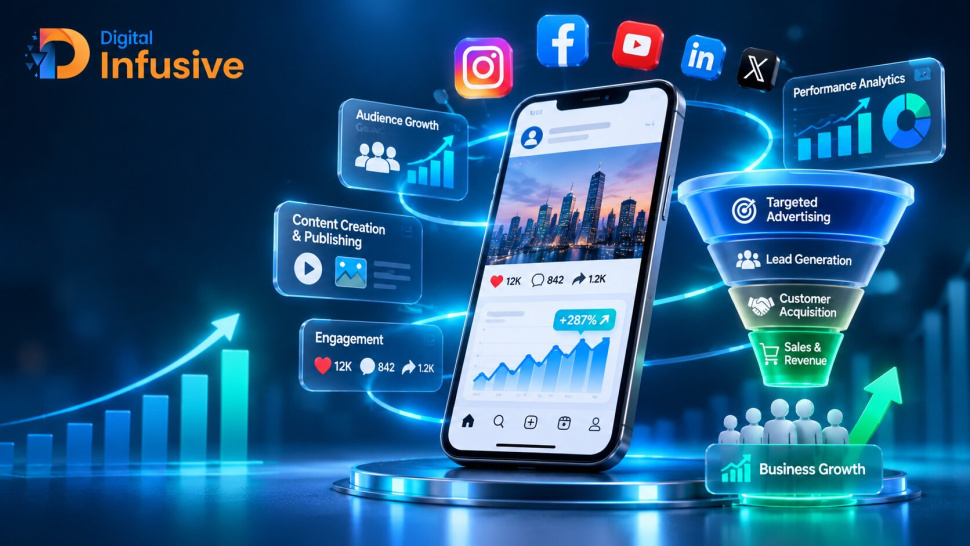
Businesses that treat social media as a broadcast channel — pushing promotions without understanding their audience — struggle to see returns. Those that approach it strategically — with clear goals, defined audiences, purposeful content, and measurable conversion paths — turn their social media marketing services investment into tangible business growth.
The challenge is no longer whether a business should be on social media. It is whether that business can connect its social media effort with real revenue. This guide explains how to build a strategy that does exactly that.
What Is a Social Media Marketing Strategy?
A social media marketing strategy is a structured plan that defines what a business wants to achieve through social media, who it wants to reach, what content it will create, which platforms it will use, and how it will measure success.
It is fundamentally different from simply maintaining a social media presence. Having active accounts and posting regularly is a starting point, not a strategy.
A genuine strategy includes:
Clear business objectives — whether that is brand awareness, lead generation, website traffic, or direct sales.
Audience research — understanding who your ideal customers are, what they care about, and where they spend time online.
Content planning — developing a social media content calendar with purposeful content aligned to each stage of the buyer journey.
A mix of organic and paid approaches — using organic social media growth to build community and paid social media advertising to accelerate reach and conversions.
Performance measurement — tracking metrics that connect social activity to business outcomes, not just vanity numbers.
Without these elements, social media becomes a time-consuming activity that feels productive but rarely delivers measurable results.
Why Social Media Marketing Is Important for Business Growth
Social media is one of the most accessible and cost-effective channels available to businesses of any size. When used strategically, it supports growth across multiple dimensions:
Brand awareness. Consistent, high-quality content puts your business in front of potential customers who may not know you exist.
Audience engagement. Social platforms create direct, two-way communication with your audience — something traditional advertising cannot replicate.
Customer relationships. Responding to comments, messages, and reviews builds trust and loyalty over time.
Website traffic. Well-crafted posts with clear calls to action drive qualified visitors to your website and landing pages.
Lead generation. Social media lead generation campaigns — through forms, gated content, and direct messages — capture contact information from interested prospects.
Customer retention. Staying visible and valuable in your followers' feeds keeps your business top of mind for repeat purchases.
Online reputation. An active, professional social media presence signals credibility and reliability to potential customers researching your business.
Sales opportunities. Social commerce features, product tags, and integrated shopping tools make it easier than ever for customers to buy directly from social platforms.
Businesses that also invest in strong local visibility alongside their social efforts often see compounding results. For a complementary perspective, this guide on local SEO for small businesses covers strategies that work hand in hand with social media marketing.
8 Steps to Build a Social Media Marketing Strategy That Converts
1. Define Your Social Media Marketing Goals
Start with clear, measurable objectives. Are you trying to increase brand awareness, generate leads, drive eCommerce sales, or build a community? Each goal requires different content, platforms, and tactics.
A B2B consulting firm might prioritise LinkedIn thought leadership and lead capture. An eCommerce brand might focus on Instagram product discovery and direct sales. Define what success looks like before creating a single post.
2. Identify Your Ideal Target Audience
Effective social media marketing speaks to a specific audience, not everyone. Research your ideal customers — their demographics, interests, pain points, online behaviour, and preferred platforms.
Use existing customer data, social media analytics, and competitor research to build detailed audience profiles. The more precisely you define your audience, the more relevant and effective your content becomes.
3. Select the Right Social Media Platforms
Not every platform is right for every business. A professional services firm will find more value on LinkedIn than TikTok. A fashion brand may thrive on Instagram and Pinterest but see limited returns on LinkedIn.
Choose platforms based on where your target audience is active and where your content format fits naturally, rather than trying to maintain a presence everywhere.
4. Research Competitors and Industry Trends
Study what your competitors are doing on social media — what content gets engagement, how they communicate with their audience, and where they appear to be investing. Identify gaps and opportunities that your business can fill.
Stay informed about platform algorithm changes, emerging content formats, and shifting audience preferences. Social media evolves quickly, and strategies need to adapt accordingly.
5. Develop a Consistent Content Strategy
Create a social media content calendar that maps content themes, formats, and publishing schedules across your chosen platforms. Consistency in posting frequency and brand voice builds audience familiarity and trust.
Plan content in advance, but leave room for timely, relevant posts tied to industry news or audience conversations.
6. Create Engaging and Conversion-Focused Content
Every piece of content should serve a purpose — educate, entertain, inspire, or drive action. Balance value-driven posts (tips, insights, behind-the-scenes) with conversion-focused content (product showcases, testimonials, limited offers).
Include clear calls to action. Tell your audience what to do next — visit your website, download a guide, sign up for a consultation, or make a purchase.
7. Use Paid Social Media Advertising Strategically
Organic reach alone is limited on most platforms. Paid social media advertising allows you to target specific audiences based on demographics, interests, behaviour, and even past interactions with your business.
Start with a modest budget, test different ad formats and audiences, and scale what performs. Retargeting campaigns — showing ads to people who have already visited your website or engaged with your content — are particularly effective for moving prospects toward conversion.
8. Monitor Performance and Optimise Campaigns
Track metrics that matter — engagement rate, click-through rate, cost per lead, social media conversion rate, and social media ROI. Use platform analytics and reporting tools to understand what is working and what needs adjustment.
Review performance monthly, identify patterns, and refine your strategy based on data rather than assumptions.
Which Social Media Platforms Should Businesses Focus On?
Facebook — Effective for community building, local business promotion, and highly targeted Facebook marketing through its advertising platform. Suitable for most B2C and many B2B businesses.
Instagram — Ideal for visual storytelling, product discovery, and brand personality. A strong Instagram marketing strategy combines Reels, Stories, and feed posts to drive engagement and sales.
LinkedIn — The primary platform for B2B marketing, professional networking, and thought leadership. LinkedIn marketing helps businesses reach decision-makers and generate qualified leads.
Pinterest — Powerful for visual discovery, particularly in fashion, home décor, food, and lifestyle categories. Pins have a longer lifespan than posts on most other platforms and drive meaningful website traffic.
YouTube — The leading platform for long-form video content, tutorials, product reviews, and educational series. Video content builds deeper audience connections and supports SEO.
TikTok — Effective for short-form video discovery and reaching younger demographics. Best suited for brands that can create authentic, entertaining, or educational video content.
The right platform mix depends entirely on your audience, industry, and marketing objectives. Focus your resources where your customers are, not where every other brand seems to be.
What Types of Social Media Content Generate Better Engagement and Leads?
Different content formats serve different stages of the customer journey:
Awareness stage:
Educational posts and industry insights
Short-form videos and Reels
Infographics that simplify complex topics
Behind-the-scenes content showing your team and process
Consideration stage:
Customer testimonials and case studies
Product demonstrations and tutorials
Interactive polls and questions
User-generated content and community features
Conversion stage:
Clear product or service showcases with calls to action
Limited-time offers and promotions
Lead magnets (free guides, checklists, templates)
Direct response ads with compelling landing pages
The most effective strategies use a mix of formats, testing what resonates with their specific audience and refining over time.
Organic Social Media Marketing vs Paid Social Media Advertising
Factor Organic Social Media Paid Social Advertising
Reach Limited by algorithm; grows over time Immediate, targeted reach
Audience Targeting Broad; relies on content relevance Precise demographics, interests, behaviours
Cost Time investment; no direct ad spend Requires advertising budget
Content Distribution Dependent on follower engagement Guaranteed distribution to target audience
Lead Generation Slower, relationship-driven Faster through lead forms and landing pages
Conversion Potential Indirect; builds trust over time Direct; optimised for specific actions
Long-Term Value Builds community and brand equity Generates immediate results but requires ongoing spend
Performance Measurement Engagement, reach, follower growth Cost per click, cost per lead, ROAS
Neither approach is sufficient on its own. Organic social media growth builds a loyal audience and long-term brand presence. Paid advertising amplifies reach, targets specific segments, and drives immediate results. The most effective strategies combine both.
How to Turn Social Media Followers into Paying Customers
Having thousands of followers means little if none of them become customers. Turning followers into buyers requires intentional conversion paths:
Strong calls to action. Every post, story, or video should guide the viewer toward a next step — visiting a product page, booking a consultation, or downloading a resource.
Conversion-focused landing pages. Social traffic should land on dedicated pages designed to convert, not your generic homepage.
Clear product and service messaging. Make it immediately obvious what you offer, who it is for, and why it matters.
Lead magnets. Offer something valuable — a free guide, template, audit, or exclusive discount — in exchange for contact information.
Social media advertising funnels. Structure campaigns in stages: awareness ads introduce your brand, consideration ads provide value, and conversion ads drive specific actions.
Retargeting campaigns. Re-engage people who visited your website, viewed a product, or interacted with your content but did not convert.
Customer testimonials and social proof. Showcase real customer results and reviews to build confidence and reduce purchase hesitation.
Direct engagement. Respond to direct messages and enquiries quickly. Many conversions happen through personal conversations initiated on social media.
How Much Do Social Media Marketing Services Cost?
Social media marketing costs vary significantly based on the scope and complexity of the work involved. Key factors that influence pricing include:
Number of platforms managed. Managing two platforms requires less work than managing five.
Content creation requirements. Custom graphics, professional photography, and video production increase costs compared to text-based posts.
Community management. Active comment responses, direct message handling, and audience engagement require dedicated time.
Paid advertising management. Managing ad campaigns involves strategy, creative development, testing, and ongoing optimisation.
Reporting and analytics. Regular performance reports and strategic recommendations add value but also increase the scope of work.
Monthly packages vs customised services. Some providers offer standardised social media marketing services packages, while others build custom plans based on specific business needs.
When evaluating providers, prioritise transparency in deliverables, clear communication, and a track record of measurable results over the lowest price.
Common Social Media Marketing Mistakes Businesses Should Avoid
Posting without a strategy. Random content without clear goals or audience targeting wastes time and resources.
Targeting the wrong audience. Broad, unfocused targeting leads to low engagement and poor conversion rates.
Ignoring customer comments and messages. Unresponsiveness damages trust and discourages future interaction.
Publishing overly promotional content. Audiences disengage from brands that only sell without providing value.
Inconsistent posting schedules. Irregular activity signals unreliability to both audiences and algorithms.
Buying followers or engagement. Artificial metrics inflate numbers but contribute nothing to actual business growth.
Ignoring analytics. Without reviewing performance data, you cannot know what is working or where to improve.
Using the same content on every platform. Each platform has different formats, audiences, and expectations. Content should be adapted accordingly.
Failing to include clear calls to action. Even great content underperforms when it does not guide the audience toward a next step.
When Should a Business Hire a Social Media Marketing Agency?
Many businesses attempt social media marketing internally but struggle to maintain consistency, quality, and strategic focus. Consider professional support if:
Your team lacks dedicated marketing resources and social media is handled as an afterthought.
Engagement and audience growth have stalled despite regular posting.
Content quality is inconsistent — no professional graphics, no video, no cohesive brand voice.
You are not generating enquiries or leads from your social channels.
You need professional-grade creative content — graphic design, video production, and copywriting that resonates with your audience.
Paid advertising campaigns require expert management to deliver positive returns.
You need structured reporting that connects social activity to business results.
Maintaining a consistent brand voice across multiple platforms is proving difficult.
In these situations, partnering with a professional Social Media Marketing Services provider gives you access to the expertise, tools, and creative resources needed to build campaigns that drive measurable results — without the overhead of building a full in-house team.
Final Thoughts: Turning Social Media Marketing into Measurable Business Growth
A social media presence is not a social media strategy. The businesses that generate real results from social media in 2026 are those that approach it with clear goals, deep audience understanding, purposeful content, strategic paid amplification, and disciplined performance tracking.
Every element covered in this guide — from defining objectives and selecting platforms to creating conversion-focused content and monitoring social media ROI — contributes to a framework that transforms social media activity into genuine business outcomes.
Success does not come from chasing trends or posting for the sake of posting. It comes from building a consistent, audience-centred strategy and refining it based on what the data tells you.
For businesses looking for expert guidance in digital marketing, social media strategy, and conversion-focused campaign management, Digital Infusive provides performance-driven solutions designed to help businesses attract the right audiences and achieve measurable growth.
Start with strategy. Focus on your audience. Measure everything. And let your social media presence work as hard as the rest of your business.
Frequently Asked Questions
1. What are social media marketing services?
Social media marketing services include strategy development, content creation, community management, paid advertising, audience targeting, and performance reporting across platforms like Facebook, Instagram, LinkedIn, and others. These services help businesses build brand awareness, engage their audience, generate leads, and drive sales through coordinated social media campaigns managed by marketing professionals.
2. Which social media platform is best for small businesses?
The best platform depends on your audience and industry. Facebook works well for local businesses and community building. Instagram suits visually driven brands and product-based businesses. LinkedIn is ideal for B2B companies and professional services. Choose platforms where your target customers are most active rather than spreading resources across every available network.
3. How does social media marketing generate leads?
Social media generates leads through targeted advertising, lead capture forms, gated content offers, direct messaging, and conversion-focused landing pages. By reaching the right audience with relevant content and clear calls to action, businesses can capture contact information from interested prospects and nurture them through the buying process using retargeting and follow-up campaigns.
4. How much do social media marketing services cost?
Costs vary based on the number of platforms managed, content creation requirements, advertising budgets, community management scope, and reporting needs. Standardised monthly packages and custom plans are both common. Focus on providers who offer transparent deliverables and demonstrate measurable results rather than choosing solely based on the lowest quoted price.
5. Is hiring a social media marketing agency worth it?
For many businesses, yes. An experienced agency brings strategic expertise, professional content creation, paid advertising management, and performance analytics that most small teams cannot replicate internally. If your social media efforts are inconsistent, underperforming, or consuming too much internal time without generating results, professional support can significantly improve your outcomes and return on investment.


Share the News