


SEO has become an important service for businesses that want to attract customers through organic search. However, delivering SEO consistently requires more than knowing how keywords work. Agencies need technical expertise, content resources, link-building capabilities, reporting systems, project management, and people who can manage these activities over time.
This creates a challenge for many digital agencies. A web development company may have strong technical skills but no dedicated SEO team. A branding agency may have clients asking for search visibility but lack SEO specialists. Even an established marketing agency may want to expand its service portfolio without significantly increasing its internal workforce.
White label SEO offers one way to solve this problem.
Through this model, an agency can sell SEO under its own brand while another specialised provider handles some or most of the delivery work. The agency remains responsible for the client relationship, pricing, communication, and overall service experience.
This approach can create new revenue opportunities and allow agencies to expand their offerings more quickly. At the same time, it introduces risks involving quality control, communication, pricing, transparency, and dependency on external providers.
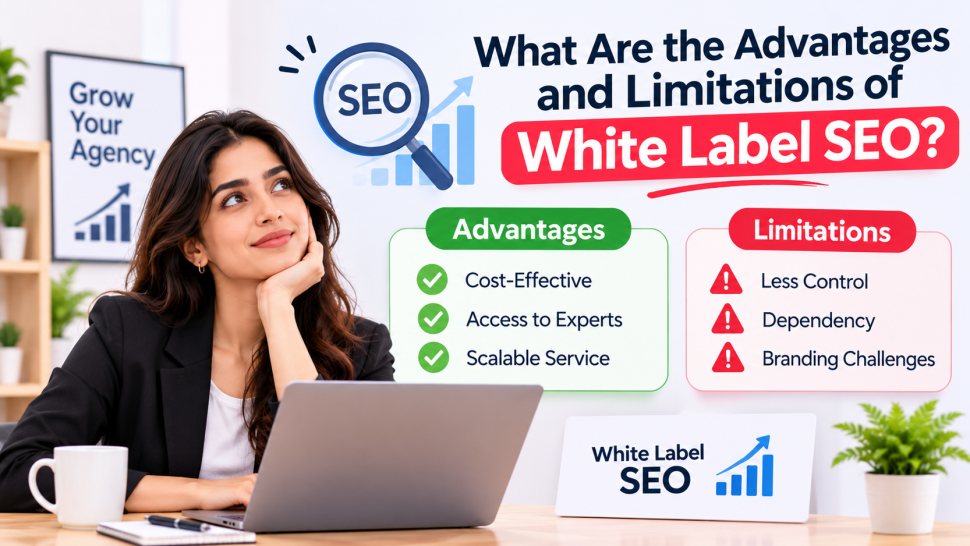
Understanding both sides is important before deciding whether white label SEO is suitable for an agency.
1. What Is White Label SEO?
White label SEO is a business arrangement where an SEO provider delivers services on behalf of another agency, allowing that agency to present the work under its own brand.
For example, imagine a digital marketing agency that provides website development and social media marketing. One of its clients asks for ongoing SEO. Instead of immediately hiring several SEO specialists, the agency partners with an external provider.
The external team may handle keyword research, technical audits, content optimisation, link building, competitor research, and reporting. The agency then reviews the work, communicates with the client, and delivers the service under its own branding.
This is commonly associated with white label seo services, where the delivery partner remains behind the scenes while the agency manages the client-facing relationship.
The exact arrangement can vary. Some providers offer complete campaign management, while others handle only specific tasks. An agency might outsource technical SEO but keep content strategy internally, or it might outsource the entire campaign and focus primarily on account management.
The important point is that white label SEO is not simply buying a list of SEO tasks at a lower price. It is a partnership model that requires coordination between the selling agency and the delivery provider.
When structured properly, it allows an agency to expand its capabilities without immediately building a large internal SEO department.
2. Advantage: Faster Expansion of Your Service Portfolio
One of the biggest advantages of white label SEO is speed.
Building an SEO department internally can take considerable time. An agency may need to recruit technical SEO specialists, content strategists, outreach professionals, analysts, and account managers. It must also develop internal processes before selling the service confidently.
A white label partnership can shorten this process.
Instead of starting from zero, an agency can work with an established provider that already has people, processes, tools, and experience. The agency can introduce SEO as a new service while gradually learning how the delivery process works.
This is particularly useful for companies that already have a strong client base.
A web development agency, for example, may have dozens of clients with websites that require ongoing optimisation. Rather than referring those clients elsewhere, the agency can add SEO to its existing service portfolio.
The same opportunity exists for branding companies, advertising agencies, content agencies, PR firms, and technology consultancies.
SEO can become an additional service rather than an entirely separate business.
This faster expansion can also help agencies respond to changing client expectations. Businesses increasingly prefer working with fewer vendors, so an agency that can provide multiple complementary digital services may have an easier time retaining clients.
3. Advantage: Lower Initial Hiring and Infrastructure Costs
Building an internal SEO team requires more than salaries. Agencies may need SEO software, training, management systems, content resources, reporting tools, and additional operational infrastructure.
White label SEO can reduce the initial investment required to offer the service.
Instead of paying for a full-time team before having enough SEO clients to justify it, an agency can work with an external provider according to its campaign requirements.
This can make the model particularly useful for smaller agencies.
Suppose an agency has five clients interested in SEO. Hiring several specialists immediately may create unnecessary fixed costs. A white label provider allows the agency to purchase delivery capacity according to its current workload.
Pricing should still be analysed carefully. Lower delivery costs do not automatically mean higher profits. The agency must account for its own sales, account management, quality control, reporting, and client support expenses.
An SEO cost calculator can be useful when estimating the resources required for different campaign types. It can help agencies think about factors such as website size, target locations, competition, content requirements, and expected workload before creating a package price.
The goal should not be to find the cheapest provider. It should be to determine whether the complete business model produces a healthy margin while maintaining acceptable service quality.
4. Advantage: Access to Specialist SEO Expertise
SEO is a broad discipline. A successful campaign may require technical knowledge, content strategy, keyword analysis, analytics, local SEO, link acquisition, and conversion optimisation.
It can be difficult for a small agency to maintain specialists in every area.
A white label provider may already have teams working across these disciplines. This gives the agency access to expertise that would otherwise require multiple hires.
For example, a technically complex website may need help with crawling, indexing, redirects, structured data, JavaScript rendering, or site architecture. A content-heavy campaign may require keyword mapping and large-scale content planning. A local business campaign may need location-based optimisation and Google Business Profile work.
Instead of building separate internal departments, the agency can access these capabilities through its delivery partner.
This can also be useful when an agency receives a client with requirements outside its current expertise.
However, agencies should verify the provider's capabilities rather than assuming that every white label company offers the same level of expertise.
Ask for examples of deliverables, understand the methodology, and evaluate how the provider handles complex problems.
5. Advantage: Greater Scalability
Scaling SEO internally can become difficult when the number of clients changes quickly.
An agency may have ten SEO clients one month and twenty the next. Hiring permanent employees for temporary increases in workload can create unnecessary costs, while relying on an overloaded internal team can reduce quality.
White label partnerships can provide additional delivery capacity.
The agency can potentially take on more campaigns without immediately expanding its permanent workforce. The external provider handles additional execution while the agency concentrates on strategy, client communication, and business development.
This can be especially useful for agencies with seasonal demand.
However, scalability should not be confused with unlimited capacity. A provider also has limits. If the agency sends too many projects without discussing capacity, turnaround times can increase and quality may decline.
Before scaling, agencies should understand the provider's maximum workload, average turnaround times, revision process, and communication structure. A scalable relationship requires planning on both sides.
6. Advantage: Agencies Can Focus More on Clients
SEO execution can involve many repetitive and time-consuming activities. Keyword research, website audits, content briefs, backlink analysis, reporting, and technical checks all require attention.
Outsourcing these activities can allow the agency to focus more heavily on client relationships.
The agency can spend more time understanding business objectives, discussing marketing strategy, presenting campaign progress, identifying new opportunities, and improving customer retention.
This is valuable because clients generally do not care which individual performs a keyword analysis or prepares a technical report. They care whether the agency understands their business and communicates clearly.
The agency therefore becomes more focused on the strategic and relationship side of the service.
However, it should not become completely disconnected from delivery. An agency that knows nothing about the work being performed may struggle to answer client questions or identify poor-quality output.
The best model usually involves agency-level oversight rather than total detachment.
7. Limitation: Reduced Direct Control Over SEO Delivery
The biggest limitation of white label SEO is that another organisation is performing work on your client's campaign.
Even if your agency owns the client relationship, you may not control every part of the delivery process.
A provider may have different standards for content quality, link acquisition, technical recommendations, or reporting. If those standards do not match your agency's expectations, you may need additional review and revision.
This creates an important responsibility for the agency: quality control.
You should establish clear requirements before starting a partnership. Define what counts as acceptable content, which link-building methods are allowed, how technical issues should be documented, and how revisions are handled.
Do not assume that the provider's internal standards automatically match yours.
Regular reviews can help identify problems before they reach clients.
8. Limitation: Quality Can Vary Between Providers
The quality of white label SEO providers varies significantly.
Some operate with experienced specialists and well-defined processes. Others rely heavily on automation, low-cost content production, or large-scale link-building methods that may not suit every client.
This is why provider selection is one of the most important parts of the model.
A low monthly price can look attractive when creating an SEO package, but the savings may disappear if the agency has to spend significant time correcting poor work.
Before signing a long-term agreement, evaluate sample reports, content, technical audits, and campaign plans. Ask how they research keywords, evaluate backlinks, handle algorithm changes, and measure campaign progress.
You should also understand how they respond when something goes wrong.
A strong provider should be able to explain its decisions rather than simply delivering a spreadsheet of completed tasks.
9. Limitation: Client Transparency Can Become Complicated
White label SEO is designed around agency branding, which means the client may not interact directly with the delivery provider.
This can create communication challenges.
If a client asks a detailed technical question, the agency needs enough knowledge to provide a useful answer. If the provider is slow to respond, the agency may also appear slow to the client.
There can also be questions about transparency.
Agencies should understand their contractual obligations and be careful about making claims regarding who performs the work. The goal should be to provide a professional service under the agency's brand without making misleading statements about expertise, resources, or processes.
Clear communication helps prevent problems.
The agency should explain what the client will receive, how often progress will be reported, what activities are included, and how strategic decisions will be made.
The client does not necessarily need access to every internal supplier relationship, but they do need accurate information about the service they are purchasing.
10. Limitation: Profit Margins Depend on Pricing Discipline
White label SEO can create attractive margins, but only if pricing is managed properly.
The agency pays the delivery provider and then charges the client a higher amount. The difference must cover the agency's operating costs and provide profit.
A common mistake is to compete mainly on price.
Suppose a provider charges ₹15,000 for a campaign and an agency sells it for ₹18,000. The apparent ₹3,000 margin may look acceptable until the agency accounts for client meetings, reporting, revisions, sales expenses, software, taxes, and management time.
Pricing should therefore be based on the complete cost of serving the client.
Agencies should also avoid creating packages that promise an unrealistic amount of work for a low fee. Large quantities of content, backlinks, audits, and optimisation tasks require resources.
A sustainable pricing model focuses on value, scope, and workload rather than simply adding a small percentage to the provider's price.
11. Limitation: Dependency on an External Provider
Another risk is dependency.
If your agency relies heavily on one provider for every SEO campaign, problems with that provider can directly affect your clients.
For example, the provider could increase prices, reduce capacity, change its team, experience operational problems, or discontinue a particular service.
Your agency should therefore maintain visibility into the work being performed.
Keep copies of important reports, campaign strategies, keyword research, content assets, and other client deliverables. Make sure your agency retains appropriate access to client-owned accounts and platforms.
For critical services, having alternative providers or some internal capability can reduce dependency.
The objective is not necessarily to eliminate outsourcing. It is to avoid creating a situation where your agency cannot operate if one external partner becomes unavailable.
12. How to Choose a Reliable White Label SEO Partner
Choosing the right provider requires more than comparing monthly prices.
Start by reviewing the provider's SEO methodology. Ask how it approaches technical SEO, content, keyword research, and link building. Make sure its practices align with the quality standards you want your agency to represent.
Look at sample deliverables. Reports should explain meaningful work rather than simply showing large numbers of completed tasks.
Ask about communication. Find out who manages your account, how quickly questions are answered, and how urgent issues are handled.
Understand turnaround times and revision policies. If a client needs changes, you should know how those requests move between your agency and the provider.
Security and access should also be considered. Client accounts, analytics data, website credentials, and business information need appropriate protection.
Finally, start with a limited engagement if possible. Test the provider's quality and communication before assigning a large portfolio of clients.
A successful partnership should reduce your workload without reducing your control over the client experience.
13. Is White Label SEO Right for Every Agency?
White label SEO is not automatically the right choice for every business.
It can work particularly well for agencies that already have strong sales and client management capabilities but lack specialised SEO resources.
It may also suit companies that want to test SEO as a new service before making a large investment in internal hiring.
However, agencies that already have a mature SEO department may prefer to keep most delivery in-house. They may have established processes, specialised employees, and greater control over campaign execution.
The decision should therefore be based on business objectives rather than the popularity of the model.
Ask whether outsourcing will improve your delivery capacity, reduce operational complexity, increase profitability, or allow you to serve clients more effectively.
If the answer is yes, white label SEO can be a useful part of your agency strategy.
Conclusion
White label SEO provides agencies with a way to expand their service offerings without immediately building a complete internal SEO department. It can provide access to specialised expertise, reduce initial hiring requirements, support scalability, and allow agencies to focus more heavily on client relationships.
At the same time, it introduces limitations. Agencies have less direct control over execution, provider quality can vary, margins require careful planning, and excessive dependence on one external partner can create operational risk.
The strongest approach is to treat white label SEO as a strategic partnership rather than a simple outsourcing arrangement. Choose providers carefully, establish quality standards, maintain oversight, price services realistically, and keep ownership of the client relationship and important campaign assets.
With the right structure, agencies can use external SEO expertise while maintaining their own brand identity and client experience. Triple Minds can also be considered as a technology and digital services partner when agencies are evaluating ways to strengthen their broader digital service capabilities.



Share the News