

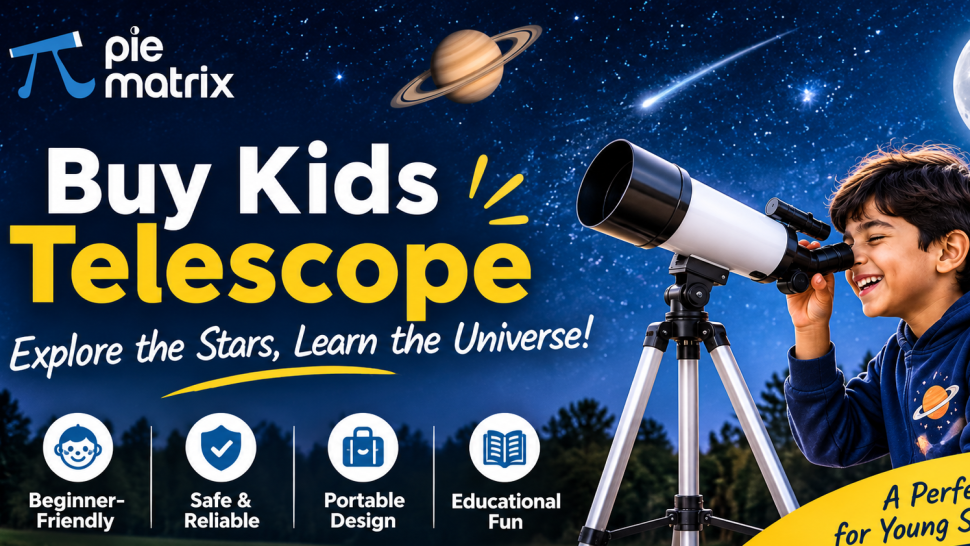

The night sky has always been something that captures the imagination of children. The Moon, the stars, the planets and the constellations can turn a perfectly ordinary evening into a very exciting one. For parents who want to encourage their kids' interest in science and space, a telescope is a very good gift. The issue is that you don't necessarily need the telescope with the highest magnification number. You need to look at how easy it is to use, how portable it is, how stable it is, the quality of the optics and the child’s actual level of interest.
If you're after a kids telescope to buy then The Pie Matrix have a range of telescopes that are perfectly suited to beginners and are designed to make stargazing as easy, fun and educational as possible.
Why should you buy a kids telescope?
Children learn through observation and experience. A telescope provides them with the opportunity to get into astronomy in a way that's not just textbook or screen based. Rather than just reading about the Moon and the planets, they can actually go out and observe them via a telescope.
A bit of a beginner telescope can go a long way to instilling patience, concentration, curiosity and an interest in science. Simply looking at the Moon’s craters or trying to find a bright planet can be a very memorable family activity.
The objective shouldn't be to buy the most expensive telescope. The best telescope is one that the child can understand, can use comfortably and will actually enjoy using.
What to Consider Before Buying a Kids Telescope
Before you buy a kids telescope think about where and how it's going to be used. A telescope for occasional use in the backyard is going to have very different requirements to one that's going to be carried on family trips.
1. Easy Setup
A complex telescope is going to put off a young novice in no time. Look for one that's easy to assemble and has simple controls. The kids should be able to get involved in the assembly of the telescope with appropriate adult supervision.
An easy setup also means that families can spend more time actually looking up at the sky rather than spending all their time fiddling with the equipment.
2. Stable Mount
Stability is one of the most important attributes of a beginner's telescope. Good optics will do little to improve the viewing experience if the telescope is shaking all over the place.
A stable tripod or a sturdy mounting system will help the kids to keep the objects in view as they're focusing on them and looking at them.
3. Suitable Aperture
Aperture is the diameter of the telescope’s main lens or mirror. It's the amount of light the telescope can collect and has a very significant bearing on the quality of the viewing.
Parents should be looking at a sensible compromise between aperture, portability, price and ease of use rather than going for a telescope simply because it's advertising ridiculously high magnification.
4. Portability
Children may of course want to use their telescope in the garden, on the terrace, at a campsite or on a family holiday. A small, portable telescope is therefore very useful.
The Pie Matrix range includes portable 'beginner' telescopes as well as the larger telescopes for those who want to go further with astronomy.
Choosing Between Refractor and Reflector Telescopes
When you buy a kids telescope you'll probably come across refractor and reflector types.
A refractor telescope uses lenses to gather and focus the light. They can be very simple to use and are often the telescope of choice for the beginner.
A reflector telescope uses mirrors rather than a front objective lens. They can have excellent light gathering power and are useful for viewing the Moon and planets.
The correct choice will of course be down to the child’s interests, the amount of space you have, where you're going to be observing from and of course your own budget.
The Pie Matrix Kids Telescope Collection
The Pie Matrix has a number of options for kids and beginners. These are the Neo Refractor, the Pegasus 76700 Reflector, the Phoenix Refractor and the Helix Reflector. Each one is aimed at a different level of interest and observing.
The Neo is the light and simple option for the beginner. The Pegasus 76700 Reflector is the one for the younger observer who wants a bit of a sharper view of the Moon and planets. The Phoenix Refractor is all about portability and comes with a good set of accessories for family stargazing. The Helix is the one aimed at the more serious amateur astronomer and one who may also be interested in astrophotography.
This range enables parents to compare the options rather than just assume that one telescope will be right for every child.
What can children see with a telescope?
The Moon is generally the best place for a beginner observer. The craters and surface detail are absolutely fascinating in the early stages of astronomical observation.
Depending on the telescope, the viewing conditions, the level of light pollution and the atmospheric stability you're looking at, children may also be able to see the bright planets and other objects. Jupiter and its major moons can be accessible with fairly basic equipment and Saturn and its rings can be an exciting target when the conditions are right.
Parents should also make it clear that what you'll see through a telescope won't be exactly like the professional space photos. Real astronomy is all about picking up on the fine detail and learning how the light, the weather and the equipment itself will impact what you can actually see.
Make Stargazing a Family Activity
A telescope is worth a hell of a lot more when the kids get to use it regularly. You just pick a clear evening, pick an easy target, and let the child go and have a look at it bit by bit.
Keeping a simple astronomy notebook can make the whole thing so much more interesting. You can just record the date, the weather, the Moon phase, the objects you've seen and your own drawings.
Parents can also use the opportunity to introduce the basics of planets, stars, constellations, orbits and the difference between our Solar System and the much more distant galaxies.
Safety Comes First
Children should be using telescopes with adult supervision, especially when it comes to setting them up and at night. Most crucially, never point a telescope at the Sun unless it has a suitable solar filter which is properly fitted. Looking at the Sun through an unfiltered telescope can cause serious and permanent eye damage.
Safe handling and responsible observation should always be part of the astronomy experience.
Buy Kids Telescope From The Pie Matrix
Choosing a telescope for a kid is all about finding the right balance between curiosity, usability, optical performance, portability and budget. A novice doesn't necessarily need the biggest, most expensive telescope. What you're looking for is equipment that will get them out there observing regularly and actually enjoy it.
If you want to Buy kids telescope, explore the kid-friendly collection from The Pie Matrix to compare beginner refractor and reflector options. With the right telescope and a little guidance, a child’s first view of the Moon can become the beginning of a lasting interest in astronomy and the wonders of space.



Share the News