

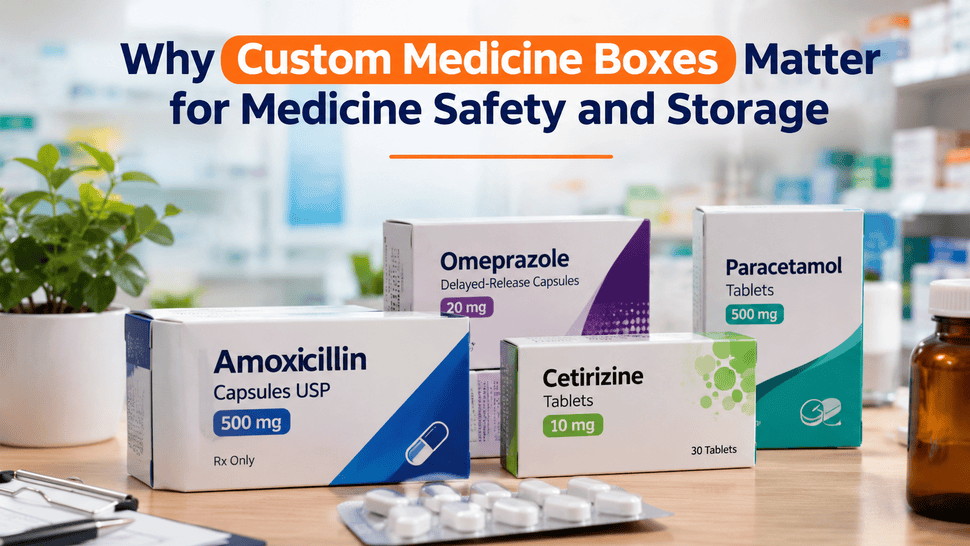

Medicine packaging does more than hold a product on a pharmacy shelf. It helps protect containers during handling, keeps important information organized, and supports safe storage. For pharmaceutical manufacturers and healthcare suppliers, Custom Medicine boxes provide a way to match carton dimensions, materials, and printed information to specific products. A properly designed box can protect a blister pack or bottle from physical damage, but it must work alongside the medicine's primary container, which provides essential protection against environmental conditions.
How Do Custom Medicine Boxes Support Product Safety?
Custom medicine boxes support product safety by protecting the primary container from physical damage and helping keep the correct medicine, instructions, and identifying information together. They are generally classified as secondary packaging because they do not directly contact the medicine.For example, a tablet blister pack may be placed inside a folding carton along with an approved patient information leaflet. The carton helps keep these components together during distribution. Its dimensions should prevent excessive movement without applying pressure that could damage the blister or its seals.
Why Is Proper Packaging Important for Medicine Storage?
Medicine storage requirements depend on the drug formulation and its approved labeling. Some medicines must be kept at controlled room temperature, while others require refrigeration or protection from light. An ordinary paperboard carton cannot independently maintain a required temperature or provide a complete moisture barrier.
Custom pharmaceutical boxes can provide an additional protective layer, but the primary packaging system is responsible for much of the medicine's environmental protection. Manufacturers must select and validate the complete packaging system according to the product's stability requirements. Storage instructions printed on the carton should match the approved product labeling.
Which Materials Are Used for Medicine Packaging Boxes?
Paperboard and corrugated cardboard are commonly used for secondary and shipping packaging. Material selection depends on product weight, carton construction, printing requirements, and distribution conditions.
Folding cartons are widely used because they can be printed, cut, creased, and supplied flat before assembly. Corrugated cartons are generally better suited to outer shipping cases. Neither material should be assumed to provide sufficient moisture, light, or temperature protection without appropriate testing.
How Does Printing Improve Medicine Identification?
Accurate printing helps healthcare professionals and patients identify medicines and read important product information. Printed medicine boxes may display the product name, strength, dosage form, quantity, warnings, storage instructions, and other required labeling details.
In the United States, over-the-counter medicines generally use the FDA's standardized Drug Facts labeling format. Prescription medicines follow different applicable labeling requirements. Packaging artwork must therefore be developed and reviewed against the requirements for the particular product rather than copied from a general carton template.
Readable typography, sufficient contrast, and clear separation of information are important. Similar-looking packages can increase the risk of product selection errors, particularly when medicines have similar names or different strengths.
What Role Does Tamper-Evident Packaging Play?Tamper-evident features help consumers identify possible interference with a medicine package before use. Depending on the product, these features may include sealed blister packs, induction seals, shrink bands, or other appropriately designed barriers.Under 21 CFR 211.132, most over-the-counter human drug products sold in the United States must use tamper-resistant packaging, subject to specified exceptions. The packaging must also carry an appropriate statement identifying the protective feature.
A regular folding carton with glued flaps does not automatically satisfy these requirements. Manufacturers must ensure that the complete packaging system meets the applicable regulations.
We Print Boxes: Selecting Custom Medicine Packaging
Choosing a supplier for medicine cartons requires attention to material specifications, printing accuracy, and box construction. Businesses exploring packaging options through We Print Boxes should first establish the approved dimensions and artwork requirements for their products. Custom Packaging must be evaluated against the intended use rather than selected only for its appearance.
For example, custom medicine packaging boxes intended to hold blister strips require sufficient internal space for the strips and any accompanying leaflet. A medicine products box containing a bottle may need a different carton structure to keep the container positioned correctly. Before production, pharmaceutical companies should verify supplier capabilities, request samples, and apply their required quality-control and regulatory approval processes.
What Should Businesses Check Before Ordering Wholesale Boxes?
Ordering medicine boxes wholesale can reduce unit costs, but pharmaceutical packaging requires more than a price comparison. Carton dimensions, material consistency, print accuracy, and production controls must be considered before approving large quantities.
Businesses comparing Custom Boxes Wholesale options should review:
- Internal dimensions and approved structural drawings.
- Paperboard grade, thickness, and material specifications.
- Printing accuracy and approved artwork proofs.
- Lot identification and traceability requirements.
- Supplier quality controls and production consistency.
- Minimum order quantities, delivery schedules, and total costs.
Custom Boxes with Logo printing may support brand identification, but required medical information must remain clear and compliant. Suppliers of Custom Boxes should also be assessed for their ability to follow approved specifications and manage production changes.
How Can Packaging Reduce Damage During Transportation?
Transportation exposes pharmaceutical products to vibration, stacking pressure, and repeated handling. Secondary cartons help organize individual units, while corrugated shipping cases provide additional structural protection during distribution.
The shipping configuration should be tested according to the product's requirements. Fragile bottles may need dividers or cushioning, while temperature-sensitive medicines require qualified temperature-controlled packaging and distribution arrangements. A stronger outer box alone cannot prevent temperature excursions.
Packaging tests can help manufacturers identify weak closures, crushed corners, and excessive product movement before products enter distribution.
Conclusion
Custom medicine boxes contribute to pharmaceutical packaging by protecting primary containers, organizing product information, and supporting handling and storage. Their effectiveness depends on appropriate materials, accurate printing, suitable dimensions, and compatibility with the complete packaging system.
Manufacturers should prioritize approved labeling, product stability requirements, tamper-evident features where applicable, and supplier quality controls. Packaging decisions based on these requirements help reduce avoidable damage and support safer medicine distribution.
Frequently Asked Questions (FAQs)
What are custom medicine boxes?
They are secondary packaging cartons designed to hold medicine containers, printed information, and accompanying materials.
Which material is commonly used for medicine cartons?
Folding carton paperboard is widely used for individual medicine cartons, while corrugated cardboard is common for shipping cases.
Do medicine boxes protect drugs from moisture?
An ordinary paperboard carton provides limited moisture protection. The validated primary packaging system provides the essential barrier.
Can medicine boxes include custom printing?
Yes. Cartons can carry approved product information, identification details, warnings, and branding.
Are tamper-evident features required for medicine packaging?
Many US over-the-counter medicines require tamper-resistant packaging under FDA regulations, with specified exceptions.



Share the News