

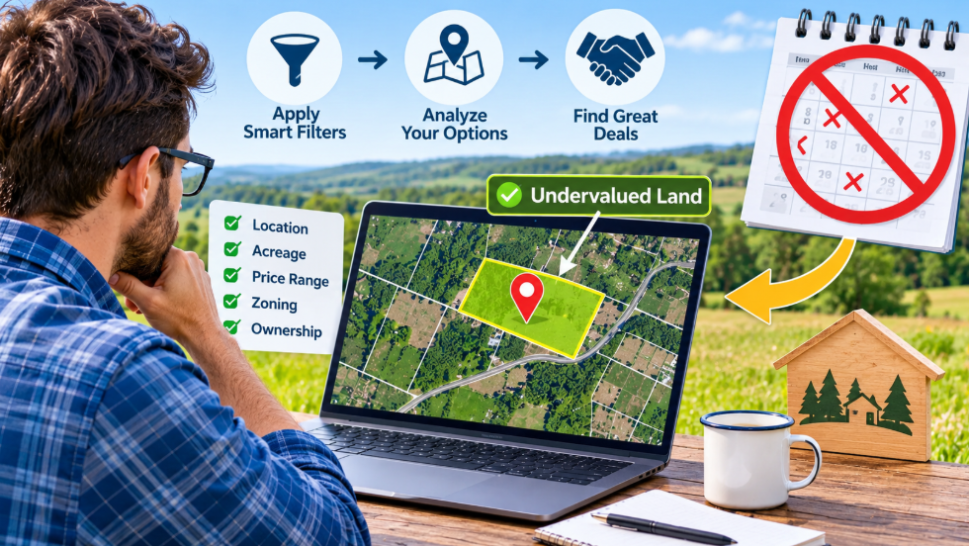

Most buyers lose time because they search everywhere at once. They open listings in ten counties, save parcels that do not fit, and start over the next weekend.
Land investing rewards clear criteria more than constant browsing. Undervalued land is rarely the cheapest parcel on a map. It is a parcel priced below similar sold parcels, with a clear reason the price stayed low.
Start With a Buy Box Before You Search
A buy box is a short list of rules for what you will consider. Without it, every parcel looks possible. With it, most parcels get rejected in seconds.
Write down county, acreage range, price per acre ceiling, allowed zoning types, and required access. Add one buyer type, such as buyers of small homesites.
If a parcel misses two rules, skip it. Keep the box narrow. Two or three counties give you enough choice to learn prices fast.
Define Your County Shortlist
Start with counties you can research and close in without travel strain. Look for steady sales volume and clear parcel records.
Check how long land stays listed. Long listing times can point to weak demand or a price set above local sales.
Set Price and Size Filters That Match Demand
Set a ceiling based on sold prices, not asking prices. If similar tracts sold near 1,200 dollars per acre, a ceiling near that level keeps you from chasing parcels priced for hope.
Size changes the buyer pool. Small tracts often attract more buyers who want a homesite.
What Land Flipping Rewards
Land flipping works when you buy a pricing gap and sell to a buyer who values the parcel as it stands.
The gap can come from an owner who wants a fast sale or a tract the market priced from poor photos and little information. The gap does not come from guessing that land values will rise.
Look for Pricing Gaps Beyond Low Prices
A low price means little until you compare it. Pull three to five closed sales from the past six to twelve months in the same county. Match acreage, zoning, access, and terrain as closely as you can.
Divide each sale price by acres to get price per acre. Example: three similar tracts sold for 1,100 to 1,300 dollars per acre. A ten-acre tract listed at 7,000 dollars total deserves a closer look.
Watch for stale listings and price drops. A parcel listed for 180 days with two cuts may have a seller ready to talk.
Build One Repeatable Weekly System
A weekly system beats weekend marathons. Set aside two focused blocks, such as ninety minutes on Tuesday and ninety minutes on Friday.
Use the first block to find new parcels and the second block to follow up and send offers. Run the same steps each time. Review new listings, price drops, and owner lists from public records, such as tax delinquent rolls.
Check the Five Deal Breakers Early
Do these checks before you make an offer.
- Access: Confirm legal road access, not a view of a road on a map.
- Zoning and use: Confirm what a buyer can build on the parcel.
- Taxes and title: Confirm taxes are current or know the amount owed. Order a title search before closing.
- Flood, slope, and wetlands: Check flood maps, slope, and wetland signs.
- Utilities and buyer fit: Note distance to power, water, and septic options.
If a parcel fails two checks, walk away unless the seller price already reflects both problems.
Make Offers From Data, Not Hope
Base each offer on your comp range, your resale buyer, and your costs. Include the purchase price, closing costs, taxes while you hold the parcel, title work, and any survey work.
If the numbers leave no room after those costs, the parcel is not a deal at your offer price. Send a clear written offer with parcel number, price, closing timeline, and any conditions.
Keep Your Search Small Until It Pays
Undervalued land hides in small patterns, not in endless browsing. A tight county list, a firm buy box, and early checks for access, zoning, taxes, flood risk, and utilities will surface better parcels with less effort.
Land investing gets easier when you stop chasing every listing. Pick your area, learn its prices, and let the same filters do the work each week.
Land Portal can support that routine by putting parcel data, ownership details, comps, and filters in one place.
Frequently Asked Questions
How Much Money Do I Need to Start?
Start with funds for purchase, closing, taxes, and title work, plus a reserve for holding costs.
How Do I Know a Parcel Is Undervalued?
Compare it with three to five closed sales of similar size, zoning, access, and terrain.
Should I Buy Land Without Road Access?
Avoid it unless you have proof of legal access or a written easement.
How Long Does It Take to Find a Deal?
Timing varies by county, price range, and how often you run your system. Weekly review often finds candidates faster.
Do I Need a Survey Before I Buy?
A survey is not always required, but it can confirm boundaries when records are unclear.



Share the News